
September 4, 2026 · Dhiraj Bashyal
Best AI Skills to Learn in 2026: In-Demand Skills, Career Paths & How to Build Them
On this page
Artificial intelligence skills are no longer restricted to machine learning researchers and data scientists. Professionals in software engineering, digital marketing, business analytics, finance, and operations now require direct capability with artificial intelligence to optimize daily workflows and remain competitive. To stay ahead in today's fast-evolving job market, exploring job-ready career training courses provides a structured pathway to master these technologies.
Understanding the landscape of ai skills helps candidates identify:
The core top ai skills needed in 2026 across technical and non-technical roles.
The precise distinction between foundational AI literacy, applied workflows, and technical model development.
How beginners can start learning ai skills without prior coding knowledge.
Practical ways to demonstrate verified ai skills for resume building and portfolio development.
What Are AI Skills?
AI skills represent the combination of technical knowledge, practical tool mastery, and cognitive capabilities required to design, deploy, or work alongside artificial intelligence systems.
To build an actionable learning plan, it is essential to distinguish between the primary categories of competencies:
AI Literacy: The fundamental ability to understand how machine learning models process information, recognize output limitations, spot hallucinations, and apply human judgment.
Generative AI Skills: The practical knowledge of using large language models and generative media tools to draft content, summarize unstructured data, and assist in creative tasks.
Applied AI Skills: Integrating specialized artificial intelligence software directly into existing domain workflows, such as marketing automation, financial modeling, or user experience research.
Technical AI Skills: Software engineering competencies required to write code, build data pipelines, query databases, and call API endpoints.
AI Automation Skills: Connecting software applications using no-code triggers, APIs, and multi-step workflow platforms to eliminate repetitive manual operations.
AI Engineering Skills: Advanced capabilities in fine-tuning open-weight models, managing vector databases, building retrieval-augmented generation (RAG) architectures, and deploying applications.
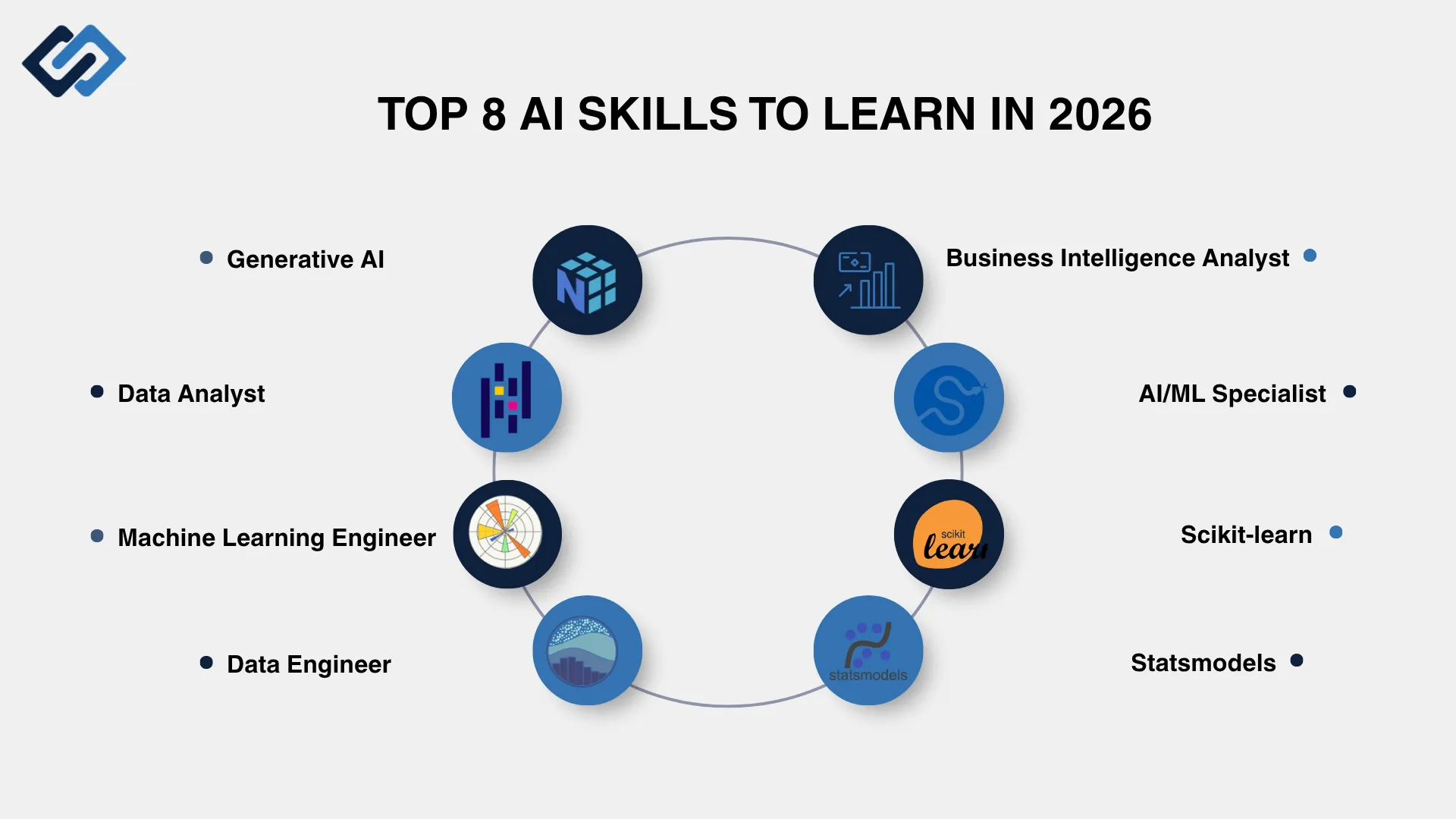
The Top 8 AI Skills to Learn in 2026
Evaluating the top AI skills to learn requires assessing five specific criteria: employer demand, practical workplace value, long-term career stability, accessibility for beginners, and salary growth potential.
1. Generative AI & AI-Assisted Workflows
Generative AI capabilities form the baseline expectation for modern knowledge workers. Mastery involves moving beyond basic conversational prompts toward structured multi-step outputs.
Working effectively with foundational LLMs (ChatGPT, Gemini, Claude).
Researching complex topics and distilling unstructured text into actionable business briefs.
Using AI assistance to write clean code, draft documentation, and debug script errors.
Evaluating generated text for accuracy, factual consistency, and logical coherence.
Maintaining data privacy, intellectual property awareness, and responsible usage standards.
2. Prompt Engineering & AI Interaction
Prompt engineering allows professionals to guide AI outputs with precision, making it an essential AI skill for beginners entry point.
Designing structured zero-shot, few-shot, and system-level instructions.
Controlling model context, output length, formatting, and operational constraints.
Establishing specific role personas and clear task boundaries.
Iterating and testing prompts to achieve consistent, production-grade results.
Creating reusable prompt templates for entire operational teams.
3. AI Data Analysis & Data Literacy
Organizations rely heavily on workers who can bridge raw database records with automated analysis tools to extract business insights.
Querying datasets using natural language tools alongside structured SQL commands.
Executing exploratory data analysis to identify operational bottlenecks.
Generating clear visualizations and executive dashboards using modern analytics stacks.
Validating automated statistical calculations against core mathematical principles.
4. AI Automation & Workflow Design
Automation transforms isolated AI tool interactions into automated enterprise operations, representing key AI skills for the future.
Building no-code and low-code automated workflows via platforms like Zapier or Make.
Orchestrating event triggers, conditions, and multi-step application actions.
Connecting software services using lightweight API integrations.
Automating recurring administrative tasks while enforcing human-in-the-loop review steps.
5. AI Tool Integration & AI Agents
Autonomous agents represent the next stage of technical adoption. Learning how agentic AI skills connect language models to live software environments is a top career driver.
Implementing tool calling mechanisms so AI can read databases and trigger web searches.
Configuring multi-agent architectures where specialized models pass context to complete complex goals.
Integrating models into established enterprise ecosystems via microservices.
Monitoring autonomous agent execution to prevent infinite execution loops or operational drift.
Selecting the right specialized platforms from the current best AI tools in 2026 to optimize team workflows.
6. Python & AI Programming Fundamentals
For technical roles, Python remains the primary programming language for artificial intelligence development.
Python syntax, control structures, and object-oriented programming concepts.
Data manipulation using Pandas and NumPy libraries.
Interacting with LLM API providers (OpenAI, Anthropic, Hugging Face).
Managing vector databases and embeddings for semantic search applications.
7. AI-Powered Content Creation
Marketing and creative teams use artificial intelligence to accelerate production velocity without sacrificing brand identity.
Generating multi-channel copy, email workflows, and social media campaigns.
Creating custom visual assets using image generation models like Midjourney or DALL-E.
Repurposing long-form webinars and documents into visual summaries.
Applying strict editorial standards, fact-checking procedures, and brand voice verification.
8. AI Evaluation, Critical Thinking & Responsible AI
As model usage expands, evaluating automated output quality and compliance becomes a core business requirement.
Detecting hallucinations, inaccurate logical inferences, and outdated context.
Identifying algorithmic bias and ensuring data privacy compliance.
Understanding legal constraints, copyright considerations, and enterprise security policies.
Deciding when automated processing is appropriate and when direct human execution is required.
Which AI Skills Are Most in Demand in 2026?
Labor market analysis shows a clear distinction between immediate operational adoption and long-term technical value.
AI Skill Category | Market Demand | Beginner Difficulty | Strategic Value | Dominant Roles |
Generative AI & Prompting | Extremely High | Low | Medium | Marketers, Operations, Product Managers |
AI Data Analysis | Very High | Medium | High | Data Analysts, Business Analysts, Finance |
AI Workflow Automation | High | Low to Medium | High | Operations Specialists, Systems Admins |
Agentic AI & Integration | Rapidly Growing | Medium to High | Very High | AI Engineers, Software Developers |
Python & ML Engineering | Consistently High | High | Very High | Machine Learning Engineers, Data Scientists |
Responsible AI & Governance | High | Medium | High | Risk Managers, Compliance Officers, Leads |
The AI Skills Gap: What Employers Need vs What Workers Have
A significant AI skills gap persists across global markets. While many candidates list general familiarization with conversational tools, few possess applied workflow proficiency.
Key factors driving this gap include:
Literacy vs Proficiency: The difference between simply asking a chatbot questions and configuring repeatable, prompt-engineered pipelines.
The Technical Implementation Gap: A shortage of workers who combine traditional software skills (Python, SQL, APIs) with modern AI capabilities.
Lack of Process Governance: Employees often deploy tools without established protocols for data security, bias auditing, or factual verification.
Which Industries Need AI Skills?
Artificial intelligence adoption spans every major economic sector:
Technology & Software: Engineering teams use generative coding assistants like GitHub Copilot and Cursor to write boilerplate code, build APIs, and construct microservices.
Finance & Banking: Financial institutions leverage automated pipelines for risk assessment, quantitative modeling, fraud detection, and financial statement analysis.
Marketing & Advertising: Growth teams deploy AI for audience segmentation, multivariate ad testing, programmatic SEO research, and visual asset generation.
Healthcare: Medical organizations apply machine learning to clinical documentation, diagnostic assistance, and administrative workflow orchestration.
E-commerce & Retail: Retail platforms rely on recommendation engines, dynamic pricing algorithms, and automated customer service agents.
Consulting & Professional Services: Consultants utilize AI research systems to analyze market trends, synthesize competitor intelligence, and build client presentations.
Education: Educational institutions employ personalized learning assistants, automated grading workflows, and adaptive curriculum platforms.
Operations & Customer Service: Enterprise operations teams use multi-agent systems to handle customer tickets, track supply chain logistics, and schedule internal tasks.
Which Jobs Benefit From AI Skills?
Mastering artificial intelligence enhances productivity and compensation potential across numerous professional career paths:
Software Developer: Accelerates feature development using intelligent IDE integrations. Professionals looking to master end-to-end development can build job-ready web applications through our Full Stack Web Development Course.
Data Analyst & Data Scientist: Automates data cleaning and exploratory analytics. Candidates seeking to build predictive models and analyze complex datasets can advance their careers with our Data Science Course.
Digital Marketer: Scales campaign output, ad copy testing, and content optimization. Marketers looking to integrate AI into performance growth funnels can explore our comprehensive Digital Marketing Course.
Product Manager: Writes technical user stories, synthesizes customer feedback datasets, and evaluates competitor features.
Business Analyst: Converts raw operational metrics into executive reports and process flow charts.
Cybersecurity Professional: Identifies automated threat vectors, audits prompt injection vulnerabilities, and protects data pipelines.
Operations Specialist: Eliminates manual data entry and builds automated cross-departmental workflows.
AI Engineer: Constructs, fine-tunes, and deploys production machine learning models and multi-agent systems.
AI Skills for Your Resume: What Should You Actually List?
To capture recruiter attention, avoid vague keyword lists. Translate your learning into measurable accomplishments.
Weak Resume Entry: "Experienced with ChatGPT and AI tools."
Strong Resume Entry: "Designed and deployed structured Generative AI workflows using LLM APIs, reducing content draft creation time by 40% while maintaining brand guidelines."
Use specific formatting transformations:
Instead of listing: "Prompt Engineering"
Write: "Engineered and evaluated structured prompt templates for automated research, resulting in a 30% increase in data retrieval accuracy."Instead of listing: "AI Tools"
Write: "Integrated GitHub Copilot and Claude Code into daily development, speeding up microservice API scaffold times by 50%."Instead of listing: "Data Analysis" Write: "Utilized Python and SQL to execute exploratory data analysis across a dataset of 100,000+ records, delivering actionable customer retention insights."
Always highlight concrete projects, specific platform tools, measurable efficiency gains, and public portfolio links.
Where Can You Learn AI Skills?
Selecting the right educational format depends on your background, career goals, and preferred learning environment:
Online Courses: Structured online courses offer flexible learning schedules, organized video modules, and guided practical assignments suitable for working professionals.
Bootcamps: Intensive bootcamps provide immersive, instructor-led training designed to move students into job-ready roles over a concentrated multi-week timeframe.
University Programs: Higher education degree programs deliver deep theoretical foundations in computer science, mathematics, and statistical modeling for long-term technical research.
Self-Directed Learning: Self-directed learning through documentation, technical blogs, and open-source tutorials allows experienced developers to pick up specific tools quickly.
Project-Based Learning: Hands-on application builds true competence by forcing candidates to solve messy real-world problems using fresh datasets and custom code.
How to Learn AI Skills as a Beginner
Follow a structured progression to transition smoothly from basic literacy to advanced application:
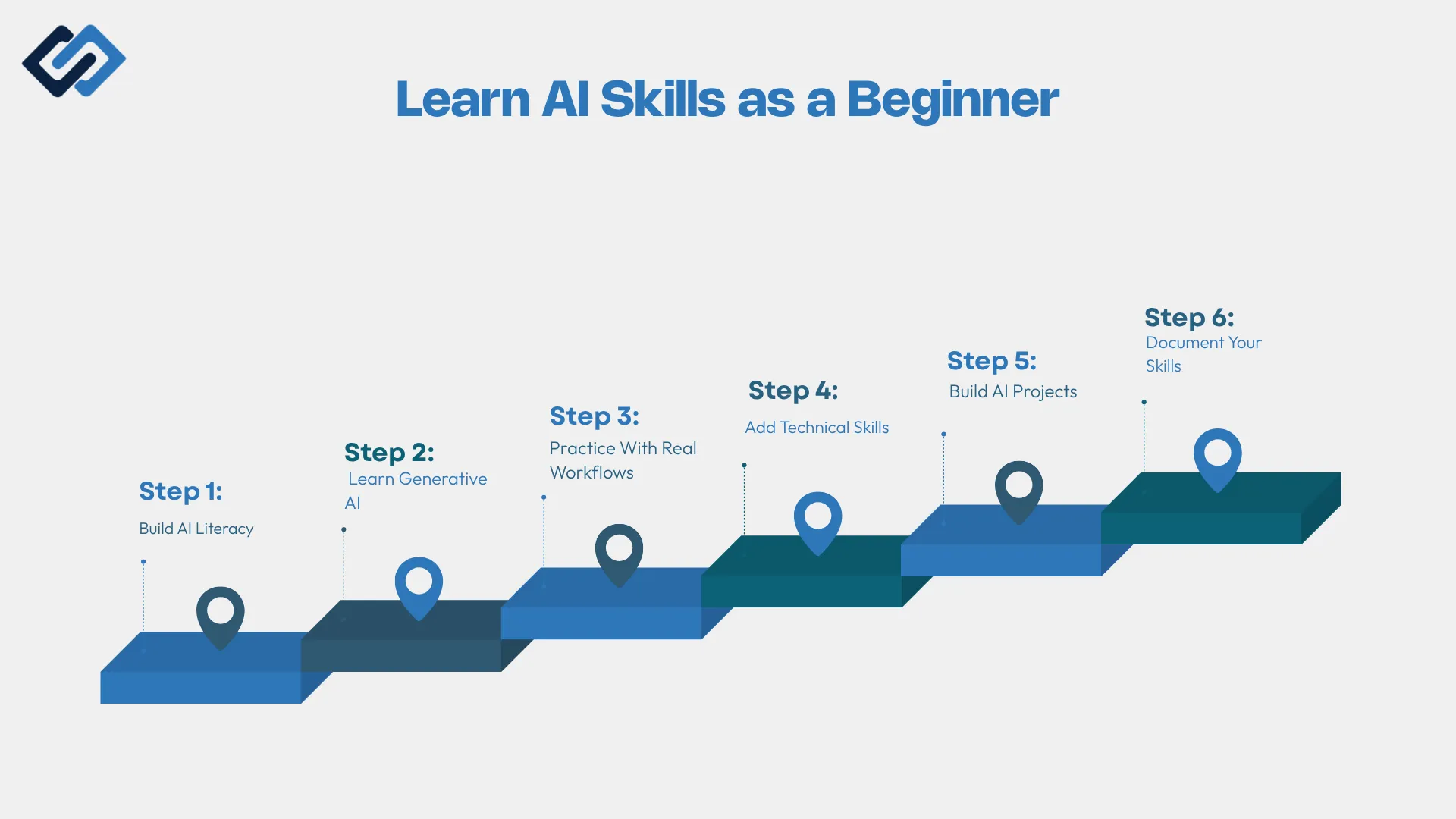
Step 1: Build AI Literacy
Understand basic artificial intelligence terms, model architecture concepts, and limitations such as hallucinations and context windows.
Step 2: Learn Generative AI
Practice structured prompting using foundational LLMs. Experiment with system instructions, context formatting, and iterative output refinement.
Step 3: Practice With Real Workflows
Apply AI tools directly to your daily work. Automate a repetitive writing task, summarize long documents, or streamline market research.
Step 4: Add Technical Skills
Learn fundamental Python programming, SQL database querying, and API interaction basics to expand your engineering options.
Step 5: Build AI Projects
Construct 3 to 5 original projects using public uncleaned datasets or custom tool integrations rather than copying simple tutorial code.
Step 6: Document Your Skills
Publish your source code on GitHub, write case studies, update your LinkedIn profile, and present working project demos to potential employers.
AI Skills Roadmap for 2026
Career Stage | Core Learning Focus | Key Target Skills | Primary Deliverable |
Beginner | AI Literacy & Generative AI | LLM usage, structured prompting, basic evaluation | Reusable prompt template library |
Intermediate | Applied AI & Automation | No-code workflows, SQL, AI data analysis, API calls | Automated cross-tool workflow |
Advanced | Technical AI Development | Python, vector databases, RAG framework, tool calling | Functional AI web application[cite: 2, 4, 7] |
Career-Ready | Enterprise Engineering | Agentic orchestration, fine-tuning, model deployment, MLOps | Public GitHub project portfolio[cite: 1, 2, 5] |
AI Skills for Different Career Goals
Tailor your learning plan to match your target role:
For Software Developers: Focus on AI-assisted coding tools (Cursor, Copilot), LLM API integration, vector databases, and constructing multi-agent architectures.
For Data Professionals: Prioritize Python, SQL, statistical modeling, machine learning algorithms, and automated data visualization pipelines.
For Marketing Professionals: Master prompt engineering, programmatic SEO, visual asset creation, and automated email/ad campaign workflows.
For Business Professionals: Focus on AI literacy, automated spreadsheet processing, project management tools, and responsible AI governance.
For Career Changers: Begin with basic AI literacy and prompt engineering before committing to specialized technical training programs in web development, data, or digital marketing. Candidates in international markets, including the USA, UK, Canada, and Australia, should focus on practical, project-backed skill sets that match regional hiring demand.
For Students: Combine strong academic foundations in math or business with practical GitHub project experience and hands-on AI tool usage.
How to Prove You Have AI Skills
Collecting course certificates is a starting point, but employers prioritize verified proof of performance:
GitHub Repositories: Maintain clean, well-documented code repositories featuring original project logic and detailed documentation.
Live Application Demos: Deploy working web applications or interactive dashboards that hiring managers can test directly.
Detailed Case Studies: Write comprehensive project breakdowns outlining the business problem, technical architecture, and measurable outcomes achieved.
Resume Impact Metrics: Feature quantified operational results, such as percentage time saved or error rates reduced through automation.
Active LinkedIn Presence: Share original insights, build in public, and discuss practical lessons learned while working with new technologies.
Build AI Skills That Move With the Job Market
The demand for artificial intelligence capabilities is reshaping career trajectories across every industry. While generative tools and agentic frameworks change daily, professionals who combine strong foundational knowledge with practical execution will consistently stand out. Focus on building real-world projects, mastering core technical tools, and applying artificial intelligence to solve concrete business challenges.
To take the next step in your career, explore our job-aligned Commit Career Training Programs and gain the practical skills needed to thrive in an AI-driven economy.