
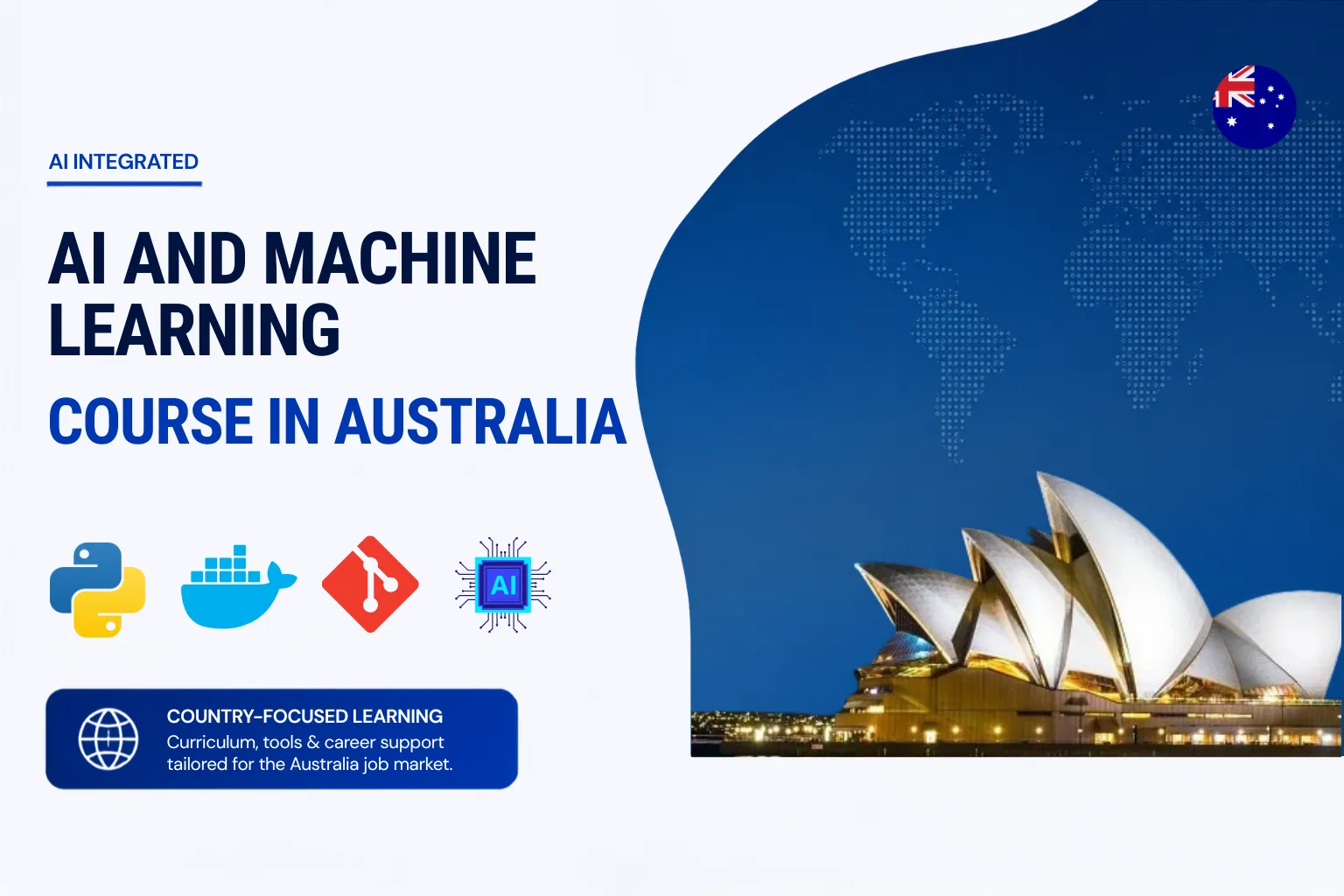
AI and Machine Learning Course in Australia
Learn AI and machine learning from the ground up with hands-on training in Python, statistics, deep learning, and generative AI, and graduate with a live portfolio and deployed projects built for Australia's growing AI job market.
Overview
Learn AI and Machine Learning with Commit Career
The AI and Machine Learning Course by Commit Career is built to meet learners where they're searching, starting broad with AI, and then developing the specific, technical machine learning skills that Australian employers are hiring for.
Guided by a structured curriculum and hands-on projects, you will build practical fluency in data wrangling, supervised and unsupervised learning, neural networks, and generative AI application development using large language models (LLMs). Beyond theory, you will train and evaluate real models, build a retrieval-augmented generation (RAG) application, and deploy a model to a live endpoint, developing the same workflow skills used by machine learning engineers, data scientists, and AI engineers across Australian industry.
Whether you're comparing an AI course in Melbourne, Sydney, Perth, or Adelaide, searching for a structured machine learning course, or trying to work out what an AI course in Australia should actually teach you, this program is built to take you from fundamentals to a working, deployable portfolio.
Who This Course Is For
Complete beginners across Australia looking for an AI course with no prior coding, statistics, or machine learning background
Software developers and engineers in Melbourne, Sydney, Perth, Brisbane, and Adelaide moving into machine learning engineering roles
Data analysts progressing from reporting and dashboards into predictive modelling and applied AI
University students wanting practical, portfolio-ready machine learning skills to complement academic study
International students in Australia building an AI and machine learning portfolio for the local tech hiring market
Career changers from Australia's resources, agriculture, finance, and health sectors moving into AI-driven roles
Working professionals upskilling in AI and machine learning around a full-time job
Why Choose Commit Career's AI and Machine Learning Training?
Many AI courses stop at demonstrations and theory. Commit Career is built around getting you to a deployable, explainable, portfolio-ready system.
Full-Stack AI/ML Curriculum: Covers the complete pipeline from Python and statistics through classical machine learning, deep learning, generative AI, and deployment, not just isolated demos.
Hands-On Model Building: Apply what you learn on real, publicly available datasets: cleaning data, engineering features, training and evaluating models, and comparing algorithm performance.
Generative AI & LLM Specialisation: Learn to build applications with modern large language model APIs (OpenAI, Claude, Gemini), including prompt engineering, embeddings, and retrieval-augmented generation, alongside traditional machine learning.
Career Development Support: Build a GitHub-based machine learning portfolio, prepare for technical interviews used by Australian employers, and strengthen your resume and LinkedIn profile for AI and data roles.
Learn Anytime, Anywhere: Study online on a flexible schedule, wherever you are in Australia, without sacrificing hands-on depth.
AI and Machine Learning in Australia: Market Value and Course Context
Australia classifies data science and machine learning work under the Data Scientist occupation profile maintained by Jobs and Skills Australia (OSCA code 223234), which describes the role as building and deploying analytics frameworks, including machine learning, to support strategic planning and decision-making. This is a useful anchor for what "machine learning skills" concretely means to Australian employers: not just running notebooks, but preparing data, building models, and presenting decision-ready insights.
Demand for these skills sits within a broader pattern of growth in professional and ICT roles across the Australian labour market. Jobs and Skills Australia projects Professional occupations (a group that includes data and AI-related roles) to grow by around 456,900 people, or 11.6 percent, by 2030, and by 845,300 people, or 21.4 percent, by 2035. Within Managers, ICT Managers are projected to be among the fastest-growing occupations over the coming decade, reflecting rising demand for technology and AI leadership across Australian organisations.
AI and machine learning talent is not concentrated in one city. Sydney's banking and fintech sector, Melbourne's enterprise technology and retail analytics scene, Perth's resources and mining industry (where predictive maintenance and geospatial modelling are common ML applications), and Adelaide's defence and space technology sector each apply machine learning differently, which is reflected in how learners across these cities search for and use AI training.
How AI Powers This Program
Artificial intelligence tools are not just the subject of this course, they are part of how you learn and build throughout it. You'll use AI-assisted coding tools, AI research assistants, and generative AI APIs directly inside your projects, mirroring how AI and machine learning teams in Australia actually work in 2026.
Course Phase | What You Learn | AI Tools Used | Your Output |
|---|---|---|---|
Phase 1: Foundations & Problem Framing | ML fundamentals, data literacy, translating a business question into an ML problem | ChatGPT, Claude | A documented problem statement and data audit |
Phase 2: Data Wrangling & Exploratory Data Analysis | Data cleaning, feature engineering, exploratory data analysis | ChatGPT, AI-assisted Pandas workflows | A cleaned dataset with an EDA report |
Phase 3: Supervised & Unsupervised Learning | Classification, regression, clustering, model evaluation | Scikit-learn, AI-assisted model selection tools | Trained baseline models with evaluation metrics |
Phase 4: Deep Learning | Neural networks, CNNs, RNNs, Transformers | TensorFlow, PyTorch, Claude for debugging | A trained deep learning model |
Phase 5: Generative AI & LLMs | Prompt engineering, embeddings, retrieval-augmented generation | OpenAI API, Claude API, Gemini API | A working AI-powered application prototype |
Phase 6: MLOps & Deployment | Model deployment, containerisation, monitoring | Docker, AWS SageMaker, MLflow | A deployed and monitored ML model endpoint |
Phase 7: Capstone Project | End-to-end ML project: problem framing through deployment | All tools above | A portfolio-ready ML case study with a live demo |
What you'll learn
- Python for Machine Learning and Data Science
- Statistics and Mathematics Foundations for ML
- Supervised and Unsupervised Learning Algorithms
- Deep Learning and Neural Networks
- Generative AI and Large Language Models
- MLOps, Deployment, and Cloud ML Platforms
- Data Engineering and Feature Pipelines
- Model Evaluation and Experimentation
- AI Ethics and Responsible Machine Learning
Curriculum
8 modules • 50 lessons • 12 weeks
Module 1: Foundations of AI & Machine Learning
- What Is Machine Learning: Supervised, Unsupervised & Reinforcement Learning
- The AI/ML Landscape: From Statistics to Generative AI
- Problem Framing: Translating Business Questions into ML Problems
- Data Fundamentals: Data Types, Sources & Quality
- Python and Maths Foundations for Machine Learning (linear algebra, probability, statistics primer)
- The ML Project Lifecycle & Industry Workflow (CRISP-DM, MLOps overview)
Module 2: Python, Data Wrangling & Exploratory Data Analysis
- Python for Machine Learning (NumPy, Pandas, Jupyter)
- Data Cleaning and Preprocessing Techniques
- Exploratory Data Analysis and Visualisation (Matplotlib, Seaborn)
- Feature Engineering and Feature Selection
- Handling Missing Data, Outliers, and Imbalanced Datasets
- Working with Structured vs. Unstructured Data
- SQL and Data Retrieval for ML Pipelines
Module 3: Supervised Learning: Regression & Classification
- Linear and Logistic Regression
- Decision Trees and Random Forests
- Support Vector Machines
- k-Nearest Neighbours and Naive Bayes
- Model Evaluation Metrics (accuracy, precision, recall, F1, ROC-AUC)
- Cross-Validation and Hyperparameter Tuning
Module 4: Unsupervised Learning & Advanced Algorithms
- Clustering (k-Means, Hierarchical, DBSCAN)
- Dimensionality Reduction (PCA, t-SNE)
- Ensemble Methods (Bagging, Boosting, XGBoost, Gradient Boosting)
- Anomaly Detection Techniques
- Recommendation Systems Basics
- Association Rule Learning
Module 5: Deep Learning & Neural Networks
- Neural Network Fundamentals and Architecture
- Building Models with TensorFlow and PyTorch
- Convolutional Neural Networks for Computer Vision
- Recurrent Neural Networks and Sequence Modelling
- Transformers and Attention Mechanisms
- Transfer Learning and Pretrained Models
- Model Regularisation and Optimisation Techniques
Module 6: Generative AI & Large Language Models
- Foundations of Generative AI and LLMs
- Prompt Engineering for AI Applications
- Working with OpenAI, Claude, and Gemini APIs
- Retrieval-Augmented Generation (RAG) Systems
- Fine-Tuning and Embeddings
- Responsible AI: Bias, Fairness & Limitations
Module 7: MLOps, Deployment & Production Systems
- Model Deployment Fundamentals (Flask, FastAPI)
- Containerisation with Docker for ML
- Cloud ML Platforms (AWS SageMaker, GCP Vertex AI, Azure ML)
- CI/CD for Machine Learning Pipelines
- Model Monitoring and Drift Detection
- Version Control for Data and Models (MLflow, DVC)
Module 8: Career Readiness & Capstone
- Machine Learning Portfolio and GitHub Strategy
- Resume, LinkedIn, and Technical Interview Preparation for the Australian Market
- Machine Learning System Design Interview Practice
- Kaggle Competitions and Community Engagement
- Specialised Career Tracks (ML Engineer, Data Scientist, AI Engineer, Applied Scientist)
- End-to-End Capstone Project Presentation
Meet Your Mentor

Sailesh Adhikari
Data Science & Machine Learning Mentor
Meet Mr. Sailesh Adhikari, Data Science & Machine Learning mentor. He guides learners through real-world datasets and projects, making complex concepts practical, hands-on, and easy to apply.
Projects & Case Studies
This course's project gallery is still in development — check back soon.
Frequently asked questions
What's the difference between an AI course and a machine learning course?
Machine learning is a subset of artificial intelligence focused on models that learn patterns from data. Most "AI course" searches in Australia are really looking for practical machine learning training, sometimes combined with generative AI and large language models. This course covers both: classical machine learning as the foundation, extended into generative AI and LLM application development.
Do you offer this AI course in Melbourne, Sydney, Perth, or Adelaide?
The course is delivered online, so you can study it from Melbourne, Sydney, Perth, Adelaide, or anywhere else in Australia. There's no need to attend an in-person campus in any particular city, though you'll be learning alongside a program shaped by real, city-relevant industry applications.
Do I need a university degree to enroll?
No formal degree is required to enrol. Some Australian employers and regulated skills-assessment pathways do have their own qualification requirements, which are separate from and not guaranteed by this course.
Will this course help me meet skills-assessment requirements for tech roles in Australia?
This course builds practical machine learning and AI skills but is not a substitute for formal qualification or a guarantee of a successful skills assessment. If a skills assessment or migration pathway matters to you, confirm requirements directly with the Australian Computer Society or a registered migration agent.
What industries in Australia use machine learning the most?
Banking and fintech (particularly in Sydney and Melbourne), resources and mining (particularly in Perth and Western Australia), agriculture and agtech, health, and increasingly defence and space technology (particularly around Adelaide) are among the strongest applied-ML industries in Australia.
Related Courses
 $699Featured
AI and Machine Learning Course in Canada
Learn AI and machine learning from the ground up with hands-on training in Python, statistics, deep learning, and generative AI, and graduate with a live portfolio and deployed projects built for Canada's AI job market.
 $699Featured
AI and Machine Learning Course in the UK
Learn artificial intelligence and machine learning from the ground up with hands-on training in Python, statistics, deep learning, and generative AI, and graduate with a live portfolio and deployed projects built for the UK's fast-growing AI job market.
 $698Featured
AI and Machine Learning Course in USA
Learn AI and Machine Learning from the ground up with hands-on training in Python, statistics, deep learning, and generative AI, and graduate with a live portfolio and deployed projects that prove you can build real machine learning systems.