
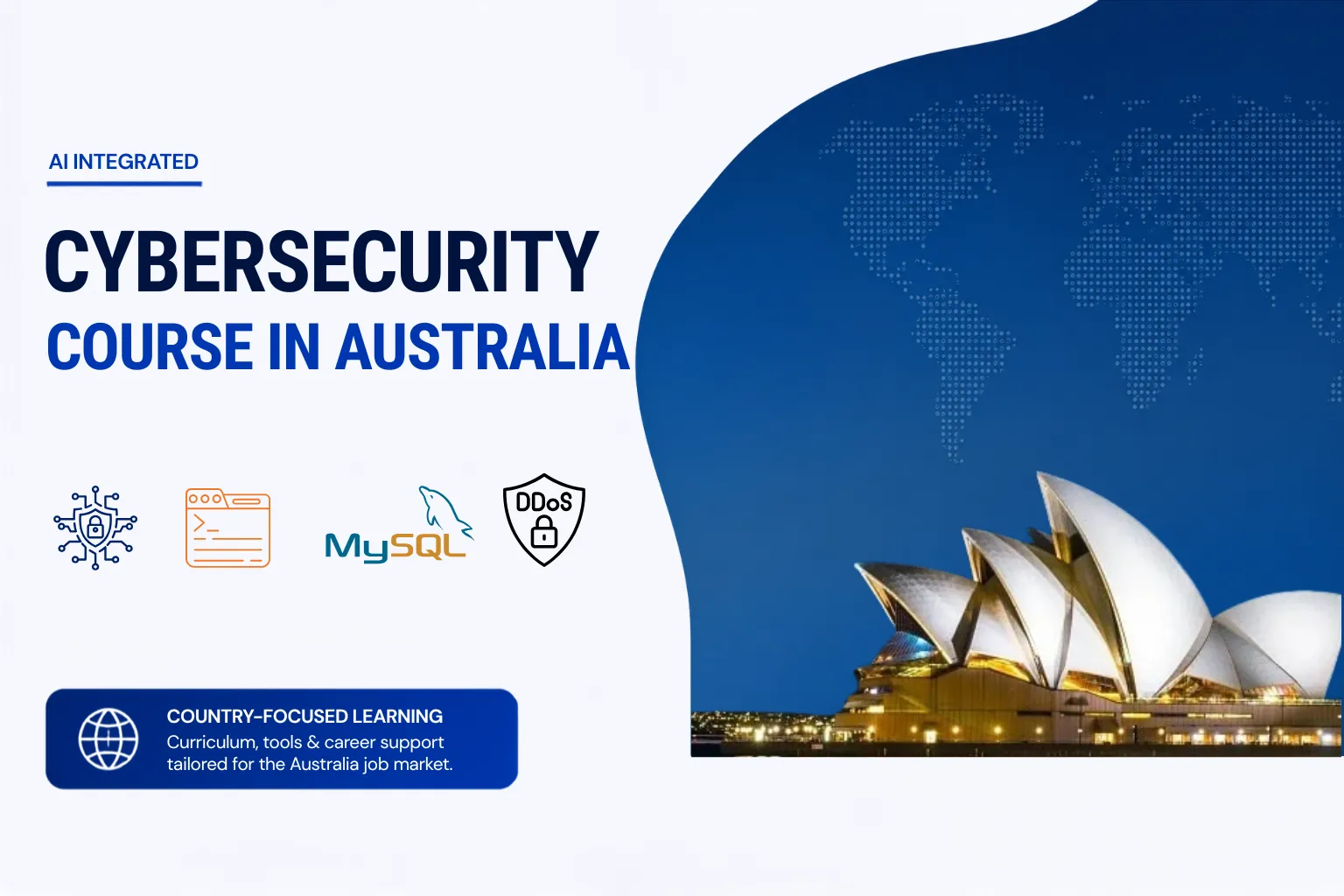
Cybersecurity Course in Australia
Cybersecurity Course in Australia Learn cybersecurity from the ground up with hands-on training in network defence, ethical hacking, security operations, incident response, cloud security, and AI-powered security tools, and graduate with a live portfolio that proves you can protect real systems.
Overview
Learn Cybersecurity with Commit Career
From the banks and insurers headquartered in Sydney and Melbourne to the mining and resources companies that anchor Western Australia and Queensland, and the government and defence presence concentrated in Canberra, Australian organisations of every size now depend on people who can find weaknesses before attackers do and respond quickly when something goes wrong. The Cybersecurity Course by Commit Career is an intensive, project-driven program built to take ambitious learners across Australia from zero security experience to job-ready, portfolio-backed security professionals.
Guided by a structured security roadmap and industry mentors, you will build practical mastery over network defence, ethical hacking, security operations, incident response, cloud security, and governance, risk, and compliance (GRC). Beyond theory, you will develop core cybersecurity skills including firewall and network hardening, vulnerability scanning, SIEM-based threat detection, digital forensics fundamentals, cloud identity management, and AI-assisted security workflows, learning the exact processes security teams across Australian industries use to protect organisations from evolving threats.
Whether you're comparing cybersecurity courses online, researching a cybersecurity degree versus a shorter training program, or looking for cybersecurity training you can complete around a job or study load, this program delivers a production-grade security portfolio, a program completion certificate, and the practical confidence to pursue entry-level cybersecurity jobs or an internship in the Australian market.
Who This Course Is For
Complete beginners in Australia looking for hands-on cybersecurity training with no prior IT, networking, or security background
Career changers across Australia moving into cybersecurity from IT support, network administration, or unrelated non-technical fields
Australian university and TAFE students who want practical, job-ready security skills alongside or instead of a full cybersecurity degree
International students studying in Australia who want a structured, portfolio-driven credential to strengthen their standing in the local job market
IT professionals in Australia (help desk, sysadmin, network administrator) upskilling into dedicated cybersecurity roles
Working professionals across Australian states balancing a full-time job while completing cybersecurity courses online on a flexible schedule
Self-taught security enthusiasts in Australia who have completed scattered tutorials, home labs, or capture-the-flag challenges but have never followed a structured, mentor-guided program
Why Choose Commit Career's Cybersecurity Training?
Plenty of cybersecurity courses teach isolated concepts in a lecture format. At Commit Career, the focus is on helping you become a confident, job-ready security practitioner through practical, hands-on experience.
Industry-Focused Curriculum: Master the full cybersecurity ecosystem, including network security, ethical hacking, security operations (SOC), incident response and digital forensics, cloud security, and governance, risk, and compliance.
Practical Security Projects: Work through simulated environments covering vulnerability assessments, SOC monitoring and alert triage, incident response case studies, and cloud security audits, so you finish with proof of applied skill, not just completed modules.
AI-Powered Security Skills: Learn how security analysts use ChatGPT, Google Gemini, Claude AI, Microsoft Copilot for Security, and SIEM-integrated AI assistants to speed up threat detection, reporting, and investigation.
Career Development Support: Build a professional security portfolio, optimise your LinkedIn profile, strengthen your resume, prepare for interviews, and understand how entry-level hiring actually works in the Australian cybersecurity job market.
Learn Anytime, Anywhere: This is a fully online cybersecurity course you can study from anywhere in Australia, with a flexible schedule that fits around work, study, or family commitments.
Cybersecurity in Australia: Why This Course Matters Here
Australia's cybersecurity landscape has a distinct regulatory backbone that shapes how security teams actually operate. The Australian Cyber Security Centre (ACSC), part of the Australian Signals Directorate, publishes the Essential Eight, a set of baseline mitigation strategies that a large share of Australian organisations, especially in government and regulated industries, are expected to implement and mature over time. The Privacy Act 1988 and its Notifiable Data Breaches (NDB) scheme set out how organisations must handle personal information and respond when it's compromised, while the Security of Critical Infrastructure Act (SOCI Act) places additional obligations on sectors such as energy, water, healthcare, and communications. This course introduces that regulatory context directly, so what you learn maps to how Australian organisations are actually expected to operate.
Search demand around broad terms like "cybersecurity courses" and "cybersecurity courses online" reflects a large, engaged learner base across Australia, while more specific searches like "cybersecurity companies Australia," "cybersecurity intern," and "cyber security jobs salary" show that many of those learners are already thinking practically about where the jobs are and what a realistic career path looks like. This course is built to speak to both: the "which course is right for me" stage and the "what does this actually lead to" stage.
Industry & Future Trends Shaping Cybersecurity in Australia
ACSC's Essential Eight maturity model continues to shape hiring priorities across government and increasingly across regulated private-sector organisations.
The Notifiable Data Breaches scheme keeps incident response and breach-handling capability a standing priority for Australian organisations of all sizes.
The Security of Critical Infrastructure Act is expanding cybersecurity obligations for sectors like energy, water, healthcare, and telecommunications, sectors with a significant footprint across Australia.
Continued cloud migration across Australian enterprises is shifting entry-level hiring demand toward cloud security and identity management skills, not just traditional network security.
AI-assisted security tooling, including SIEM copilots and automated alert triage, is becoming standard in Australian security operations centres, changing what day-one SOC analyst work looks like.
How AI Is Transforming Cybersecurity
Artificial intelligence is changing how security teams detect threats, investigate incidents, and manage the sheer volume of alerts modern systems generate. Today's security analysts use AI-powered tools to triage alerts faster, summarise logs, draft incident reports, and surface patterns that would take much longer to find manually.
At Commit Career, AI is integrated throughout the training program. You will learn how to use ChatGPT, Google Gemini, Claude AI, and SIEM-integrated assistants such as Microsoft Copilot for Security for tasks including alert triage, threat intelligence summarisation, incident report drafting, phishing analysis, and security documentation.
Rather than replacing security expertise, AI helps analysts work faster and think more clearly under pressure. By pairing AI tools with strong fundamentals in networking, threat detection, and incident response, you'll be prepared for an Australian security industry where AI literacy is quickly becoming a baseline expectation rather than a bonus skill.
AI Tools Integration Across the Program
Course Phase | What You Learn | AI Tools Used | Your Output |
|---|---|---|---|
Phase 1: Foundations & Risk Assessment | Threat landscape, risk frameworks, security policy basics | ChatGPT, Gemini | A documented risk assessment and threat model for a sample organisation |
Phase 2: Network Defence & Monitoring | Firewalls, segmentation, IDS/IPS, secure network design | ChatGPT, Copilot for Security | A hardened network configuration and monitoring setup |
Phase 3: Offensive Security & Vulnerability Assessment | Reconnaissance, scanning, exploitation basics, web app testing | ChatGPT, AI-assisted recon and reporting tools | A penetration test report with prioritised, remediated findings |
Phase 4: Security Operations & Threat Detection | SIEM configuration, alert triage, threat hunting | ChatGPT, SIEM AI assistants | A SOC incident triage log with escalation decisions |
Phase 5: Incident Response & Forensics | IR lifecycle, evidence handling, malware analysis basics | ChatGPT, AI-assisted log and malware summarisation | A full incident response case study with forensic timeline |
Phase 6: Cloud Security & Compliance | Cloud security fundamentals, IAM, compliance mapping | ChatGPT, cloud-native AI security features | A cloud security configuration audit and compliance checklist |
Phase 7: Capstone Security Project | End-to-end assessment: recon to detection to response to reporting | All tools above | A portfolio-ready end-to-end security assessment case study |
What you'll learn
- Network Security & Defence Fundamentals
- Ethical Hacking & Penetration Testing
- Security Operations & Threat Detection (SIEM/SOC)
- Incident Response & Digital Forensics
- Cloud Security & Identity Management
- Governance, Risk & Compliance (GRC)
- AI-Powered Security Tools & Automation
- Vulnerability Assessment & Risk Management
- Security Awareness & Australian Regulatory Compliance (Privacy Act, Essential Eight)
Curriculum
8 modules • 50 lessons • 12 weeks
Module 1: Foundations of Cybersecurity & Risk Management
- What Is Cybersecurity & the CIA Triad
- Threat Landscape, Threat Actors & Attack Vectors
- Risk Assessment & Risk Management Frameworks
- Security Policies, Standards & Governance Basics
- Australian Regulatory Landscape: Privacy Act, Notifiable Data Breaches Scheme & the Essential Eight
- Cybersecurity Career Pathways & Industry Trends
Module 2: Network Security & Defensive Fundamentals
- Networking Fundamentals for Security Professionals
- Firewalls, VPNs & Network Segmentation
- Intrusion Detection & Prevention Systems (IDS/IPS)
- Wireless Network Security
- Endpoint Security & EDR Fundamentals
- Secure Network Architecture Design
- Network Security Auditing & Hardening
Module 3: Offensive Security & Ethical Hacking
- Penetration Testing Methodology & Rules of Engagement
- Reconnaissance & Footprinting Techniques
- Vulnerability Scanning & Exploitation Basics
- Web Application Security Testing
- Social Engineering & Phishing Simulation
- Penetration Test Reporting & Remediation Guidance
Module 4: Security Operations & Threat Detection
- SOC Fundamentals & Analyst Workflows
- SIEM Configuration & Log Management
- Threat Hunting & Behavioural Analysis
- Alert Triage & Incident Escalation
- Threat Intelligence & Indicators of Compromise (IOCs)
- Security Monitoring Dashboards & Reporting
Module 5: Incident Response & Digital Forensics
- Incident Response Lifecycle & Playbooks
- Evidence Collection & Chain of Custody
- Digital Forensics Fundamentals
- Malware Analysis Basics
- Memory & Disk Forensics Techniques
- Post-Incident Review & Root Cause Analysis
- Breach Notification & Australian Reporting Obligations (NDB Scheme)
Module 6: Cloud Security & Identity Management
- Cloud Security Fundamentals (AWS, Azure, GCP)
- Identity & Access Management (IAM)
- Cloud Compliance & the Shared Responsibility Model
- Container & Kubernetes Security Basics
- Cloud Security Posture Management
- Zero Trust Architecture Principles
Module 7: Governance, Risk & Compliance (GRC)
- GRC Frameworks: ISO 27001, NIST, SOC 2
- Security Audits & Compliance Assessments
- Third-Party & Vendor Risk Management
- Business Continuity & Disaster Recovery Planning
- Security Awareness Training Program Design
- Policy Development & Documentation
Module 8: AI in Cybersecurity & Career Readiness
- AI-Powered Security Tools & Workflows
- Prompt Engineering for Security Analysts
- Automating Threat Intelligence with AI
- Resume & Portfolio Optimisation for Cybersecurity Roles
- Interview Coaching for Cybersecurity Jobs in Australia
- Launching a Cybersecurity Consulting or Freelance Practice
Projects & Case Studies
This course's project gallery is still in development — check back soon.
Frequently asked questions
What does Commit Career's cybersecurity course in Australia cover?
The program covers network security, ethical hacking, security operations, incident response and digital forensics, cloud security, and governance, risk, and compliance, combined with AI-powered security tools and Australia-specific regulatory context such as the Privacy Act and the ACSC's Essential Eight. You graduate with a portfolio of hands-on security projects.
Are Commit Career's cybersecurity courses available online across Australia?
Yes. The course is delivered fully online, so learners anywhere in Australia, from major capital cities to regional areas, can study on a flexible schedule without relocating or attending in-person classes.
What's the difference between a cybersecurity course and a cybersecurity degree in Australia?
A cybersecurity degree is a longer academic program through a university, typically including broader theoretical and general education requirements. A course like this one is shorter and project-focused, built around practical, job-relevant skills you can apply immediately. Many learners use it either as a faster entry point into the field or alongside formal study.
Do I need any certifications before starting cybersecurity training?
No. This course does not require any prior cybersecurity certifications. It's designed for complete beginners as well as career changers and IT professionals who want structured, hands-on training from the ground up.
Does this course help with landing a cybersecurity intern position in Australia?
The portfolio and career support components are designed to help you present real, demonstrable skills when applying for a cybersecurity intern position or graduate program in Australia. Commit Career does not place students in internships directly and does not guarantee internship outcomes.
What cybersecurity companies in Australia hire entry-level talent?
Entry-level and junior security roles in Australia appear across major banks and insurers, mining and resources companies, telecommunications providers, managed security service providers, consulting firms, and government agencies, particularly in Canberra, Sydney, Melbourne, Perth, and Brisbane. We recommend researching current openings directly on employer career pages and Australian job boards.
Is cyber security in Australia a good career path for international students?
Cybersecurity is a growing field across Australia with demand spanning finance, resources, government, and telecommunications. Whether it's the right path depends on your visa conditions, career goals, and study requirements, so we recommend confirming study and work eligibility details with your institution's international student office alongside doing this course.
Related Courses
 $699
$699Cybersecurity Course in the UK
Learn cybersecurity from the ground up with hands-on training in network defence, ethical hacking, security operations, incident response, cloud security, and AI-powered security tools, and graduate with a live portfolio that proves you can protect real systems.
 $699Featured
Cybersecurity Course in the USA
Learn cybersecurity from the ground up with hands-on training in network defense, ethical hacking, security operations, incident response, cloud security, and AI-powered security tools, and graduate with a live portfolio that proves you can protect real systems.
 $699
$699Cybersecurity Course in Canada
Cybersecurity Course in Canada Learn cybersecurity from the ground up with hands-on training in network defense, ethical hacking, security operations, incident response, cloud security, and AI-powered security tools, and graduate with a live portfolio that proves you can protect real systems.