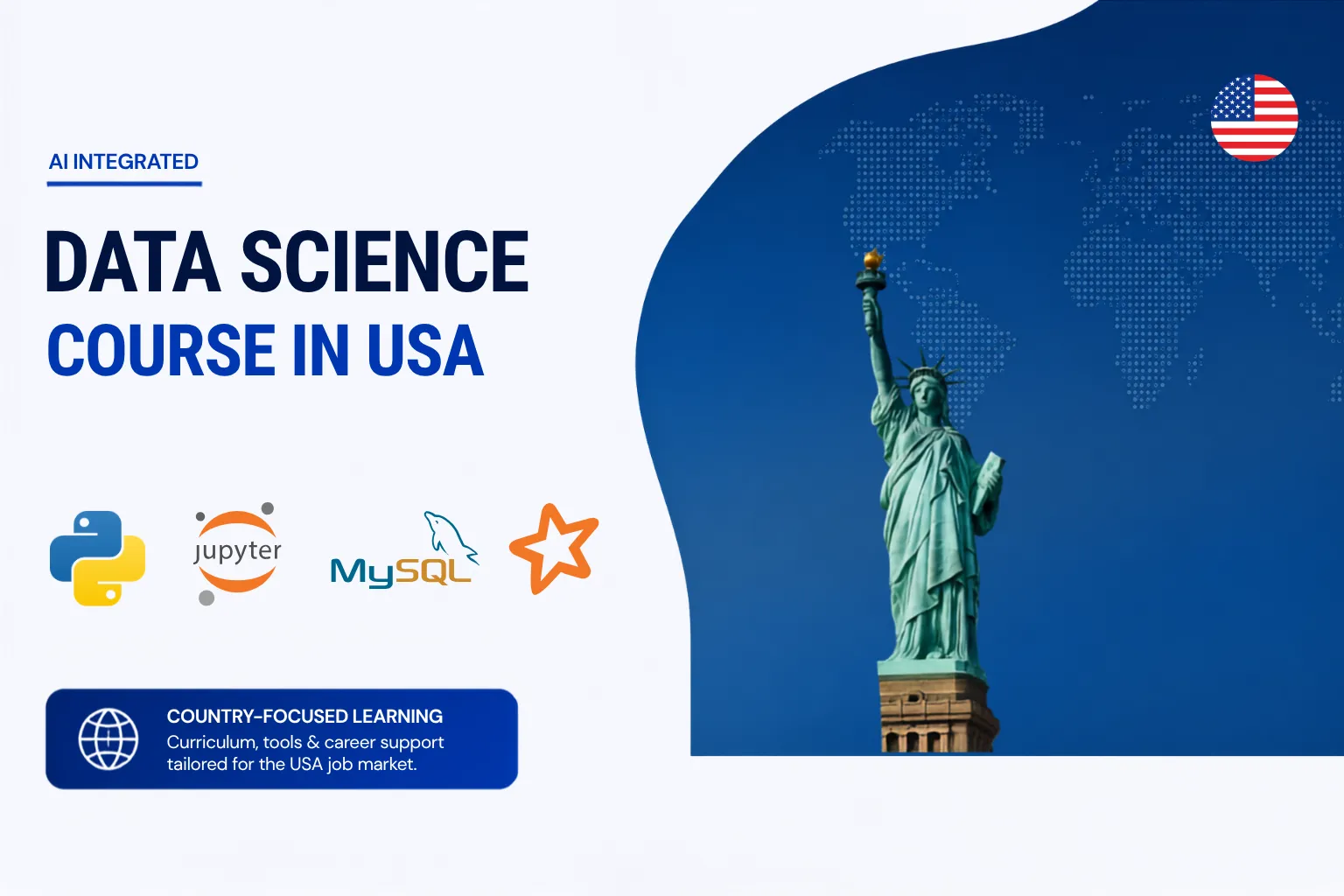
Data Science Course in the USA
Learn data science from scratch with hands-on training in Python, statistics, SQL, machine learning, and AI-powered analytics, and graduate with a live GitHub portfolio that proves you can turn raw data into real business decisions.
Overview
Learn Data Science with Commit Career in the United States
If you've been comparing data science training options in the US, you've probably noticed the same problem: a flood of free tutorials that never add up to a real skill set, and paid bootcamps that are long on marketing and short on detail about what you'll actually learn. Commit Career's Data Science Course is built to answer the questions people actually search for before enrolling: what's in the curriculum, what it costs, how long it takes, what you need to get started, and whether it leads anywhere.
This is an intensive, project-driven program engineered for learners across the United States, whether you're in a tech hub like the San Francisco Bay Area, Seattle, or Austin, a finance and business center like New York or Chicago, or studying and working remotely from anywhere else in the country. You will gain practical mastery over Python programming, statistics, SQL, machine learning, and data visualization, and you'll build the exact kind of applied, portfolio-ready project work that U.S. employers screen for when hiring data analysts and data scientists.
We'd rather be specific than promotional. This course includes a full curriculum outline (below), a certificate on completion, and career support built around the U.S. hiring process. It does not include a job guarantee, and any specific figures on course fees, program duration, or expected salary outcomes should be confirmed with an enrollment advisor or a verified source, since we don't publish unverified numbers on this page.
Who This Course Is For
Complete beginners looking for a data science course for beginners with no prior coding, statistics, or math background
Career changers moving into data science from a non-IT background, including administrative, sales, education, retail, and hospitality roles
U.S. university students and recent graduates who want practical, hands-on skills that go beyond a theory-heavy degree
Working professionals in tech and finance hubs such as the San Francisco Bay Area, Seattle, Austin, New York, Boston, and Chicago upskilling around a full-time job
International students studying in the United States who want a structured, portfolio-backed technical program to strengthen their resume for the U.S. job market
Veterans and military-to-civilian career changers transitioning into technical, data-driven roles
Business analysts, Excel-based reporting professionals, and finance professionals moving into Python-based data work
Self-taught learners who have worked through free data science courses or scattered online tutorials but want a structured program that ends in a certificate and a real portfolio
Why Choose Commit Career's Data Science Training in the USA?
There's no shortage of options when you search for a data science course in the US. Here's specifically what Commit Career is built to deliver.
A Full, Transparent Curriculum: Every module and learning point is laid out below, so you know exactly what's covered in Python, statistics, SQL, machine learning, data visualization, and AI-powered tools before you enroll, not after.
Real, Applied Data Projects: You'll work through project scenarios modeled on how U.S. companies actually use data, from churn and fraud analysis to healthcare and e-commerce datasets, not isolated textbook exercises.
AI-Native Data Science Training: Learn how working data professionals use tools like ChatGPT, GitHub Copilot, Google Gemini, and AutoML platforms to move faster through coding, exploratory analysis, and model prototyping.
Career Support Built for the U.S. Hiring Process: Resume formatting for U.S. applicant tracking systems, LinkedIn optimization, and interview coaching that reflects how American tech and data teams actually interview, including take-home case studies and live SQL/Python problem-solving.
Flexible, Self-Paced Online Format: Study from anywhere in the United States on a schedule that works around your job, classes, or other commitments, without cutting corners on hands-on practice.
Data Science in the U.S. Job Market
Data and analytics roles have become a fixture across nearly every major U.S. industry, not just Silicon Valley tech companies. Banks and financial services firms, healthcare systems and insurers, retail and e-commerce companies, government agencies and contractors, and consulting firms in cities from New York and Boston to Chicago, Austin, and Seattle are all building out data teams. What tends to separate candidates who get hired from those who don't is less about credentials and more about being able to show, concretely, that you can clean a messy dataset, build and evaluate a model, and explain what it means to someone who isn't technical.
That's the gap this course is built to close. Rather than generic theory, the curriculum, the four project scenarios, and the career support below are structured around the way U.S. companies actually evaluate junior and career-change data candidates: a GitHub portfolio, a capstone project you can walk through in detail, and the ability to hold your own in a technical interview.
We intentionally don't cite specific salary bands, hiring statistics, or visa/sponsorship information on this page, since we haven't verified current figures for those. If you'd like this section to reference sourced U.S. Bureau of Labor Statistics data or current hiring trends, that should be added with a verified citation before publishing.
How AI Is Transforming Data Science
Artificial intelligence is changing how data professionals write code, explore datasets, and communicate findings. Modern data scientists use AI-powered tools to speed up repetitive coding tasks, generate first-draft visualizations, suggest feature engineering ideas, and move through the early, exploratory stages of a project faster, freeing up time for the judgment calls that still require a human: which model to trust, which result is meaningful, and which insight is actually worth acting on.
At Commit Career, AI is built into the training program throughout, not treated as a single bolt-on module. You will learn to use tools such as ChatGPT, GitHub Copilot, Google Gemini, and AutoML platforms for writing and debugging Python code, accelerating exploratory data analysis, drafting SQL queries, and prototyping machine learning models, reflecting how data teams at U.S. companies are actually working heading into 2026.
Rather than replacing data science expertise, AI helps data professionals move faster and focus their attention on the parts of a project that genuinely require judgment. By combining AI tools with solid statistical and programming fundamentals, you'll be prepared to work the way modern data teams operate today, not the way they did five years ago.
THE AI TABLE
Course Phase | What You Learn | AI Tools Used | Your Output |
Phase 1: Foundations & Problem Framing | The data science lifecycle, business problem framing, and setting up a project | ChatGPT, Gemini | A documented project brief and problem statement |
Phase 2: Python & Data Wrangling | Python fundamentals, Pandas, and data cleaning | GitHub Copilot, ChatGPT | A cleaned, analysis-ready dataset with documented code |
Phase 3: Statistics & Exploratory Analysis | Descriptive statistics, hypothesis testing, and exploratory data analysis (EDA) | ChatGPT, AI-assisted profiling tools | An exploratory data analysis report with visualized insights |
Phase 4: SQL & Data Pipelines | SQL querying, joins, and basic ETL pipeline design | ChatGPT, GitHub Copilot | A SQL-based data extraction and transformation workflow |
Phase 5: Machine Learning | Supervised and unsupervised model building | ChatGPT, AutoML tools | A trained and evaluated machine learning model with a performance report |
Phase 6: Deep Learning & NLP Introduction | Neural network fundamentals and natural language processing basics | ChatGPT, Hugging Face AI tools | A small NLP or deep learning prototype, such as a text classifier |
Phase 7: Capstone Data Science Project | An end-to-end project: problem framing through to a deployed result | All tools above | A portfolio-ready capstone project with a working model or dashboard |
What you'll learn
- Python Programming & Data Analysis
- Statistics & Probability for Data-Driven Decisions
- SQL & Database Querying
- Data Visualization & Dashboard Design
- Machine Learning & Predictive Modeling
- AI-Powered Data Science Workflows
- Data Cleaning, Wrangling & Feature Engineering
- Deep Learning & Natural Language Processing Fundamentals
- Cloud & Big Data Fundamentals (AWS, Azure, GCP, and Spark)
Curriculum
8 modules • 49 lessons • 12 weeks
Module 1: Foundations of Data Science & Analytical Thinking
- What Is Data Science & the Data Science Lifecycle
- The Data Scientist's Toolkit: Python, SQL & Cloud Platforms Overview
- Types of Data: Structured, Unstructured & Common Data Sources
- Business Problem Framing & Analytical Thinking
- Setting Up Your Environment: Jupyter, Anaconda & Git/GitHub
- The U.S. Data & Analytics Job Landscape
Module 2: Python Programming & Data Manipulation
- Python Fundamentals for Data Science
- Data Structures: Lists, Dictionaries, Tuples & Sets
- NumPy for Numerical Computing
- Pandas for Data Manipulation & Cleaning
- Working with APIs & Web Scraping for Data Collection
- Writing Reusable Functions & Scripts
- Version Control with Git & GitHub for Data Projects
Module 3: Statistics & Probability for Data Science
- Descriptive Statistics & Distributions
- Probability Theory & Bayes' Theorem
- Hypothesis Testing & Confidence Intervals
- A/B Testing & Experimental Design
- Correlation vs Causation
Module 4: Data Wrangling, SQL & Databases
- Relational Databases & SQL Fundamentals
- Advanced SQL: Joins, Window Functions & Subqueries
- Data Cleaning & Handling Missing Data
- Feature Engineering Techniques
- Working with Cloud Data Warehouses (Conceptual Overview)
- ETL Pipelines & Data Pipeline Basics
Module 5: Data Visualization & Exploratory Data Analysis
- Principles of Data Visualization & Data Storytelling
- Matplotlib & Seaborn for Statistical Plots
- Interactive Dashboards with Plotly, Power BI & Tableau
- The Exploratory Data Analysis (EDA) Workflow
- Identifying Outliers, Trends & Patterns
- Building Business Reporting Dashboards
- Communicating Insights to Non-Technical Stakeholders
Module 6: Machine Learning Fundamentals
- Supervised vs Unsupervised Learning
- Regression Models: Linear & Logistic Regression
- Classification Algorithms: Decision Trees, Random Forest & KNN
- Clustering & Dimensionality Reduction (K-Means, PCA)
- Model Evaluation Metrics & Cross-Validation
- The Scikit-learn Workflow & Model Pipelines
Module 7: Advanced Machine Learning & Model Deployment
- Ensemble Methods: Boosting & Bagging (XGBoost, LightGBM)
- Introduction to Neural Networks & Deep Learning
- Natural Language Processing Fundamentals
- Model Deployment with Flask/FastAPI & APIs
- MLOps Basics: Monitoring & Model Versioning
- Cloud Deployment Fundamentals (AWS, Azure & GCP)
Module 8: AI, Big Data & Career Readiness
- Generative AI & LLMs for Data Science Workflows
- Big Data Fundamentals: Spark & Distributed Computing Overview
- Data Ethics, Privacy & Responsible AI
- Portfolio & GitHub Profile Optimization
- Resume, LinkedIn & Interview Preparation for Data Roles in the USA
- Career Pathways: Data Analyst to Data Scientist to Machine Learning Engineer
Projects & Case Studies
E-Commerce Customer Segmentation
Segment customers of a hypothetical U.S. online retailer to inform marketing and retention strategy
Frequently asked questions
What's included in Commit Career's data science course in the USA?
The course includes the full curriculum outlined above, covering Python, statistics, SQL, machine learning, and data visualization, four hands-on projects including a capstone, a completion certificate, and career support including resume, LinkedIn, and interview preparation.
Do I get a certificate after completing the course?
Yes, learners who complete the program receive a Commit Career completion certificate, alongside the GitHub portfolio built throughout the course.
Does the course teach Python? What programming languages are covered?
Yes, Python is the primary language taught, starting in Module 2 and used throughout the rest of the curriculum, alongside SQL for database querying and data manipulation.
Is the curriculum up to date for 2026, including current AI tools?
Yes, the curriculum includes AI-powered workflows throughout, covering tools like ChatGPT, GitHub Copilot, and AutoML platforms as they're used in current data science practice, and Module 8 specifically addresses generative AI and large language models in the data science workflow.
Related Courses
 $699
$699Data Science Course in Canada
Learn data science from scratch with hands-on training in Python, statistics, SQL, machine learning, and AI-powered analytics, and graduate with a live GitHub portfolio that proves you can turn raw data into real business decisions.
 $699Featured
Data Science Course in Australia
Learn data science from scratch with hands-on training in Python, statistics, SQL, machine learning, and AI-powered analytics, and graduate with a live GitHub portfolio that proves you can turn raw data into real business decisions.