
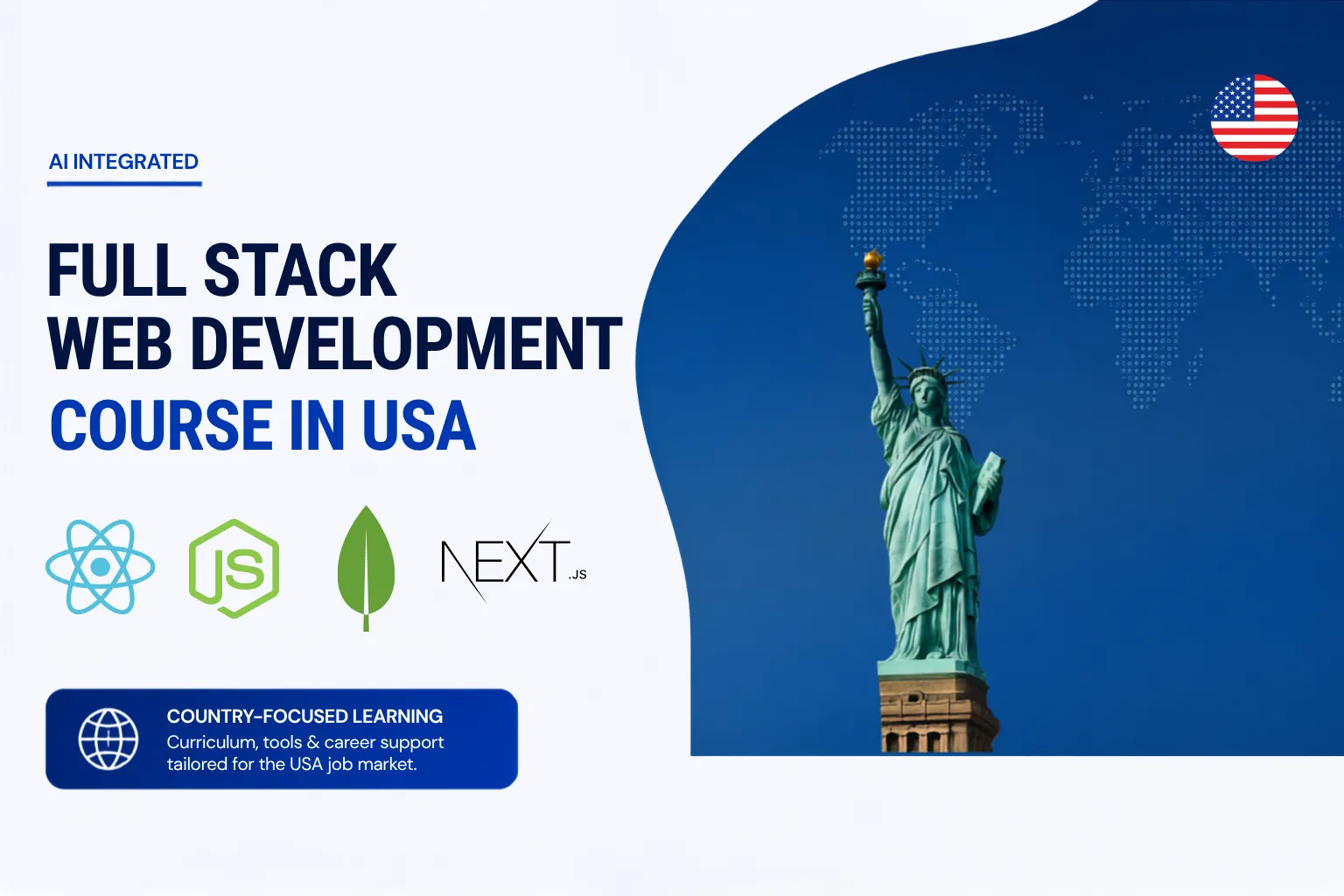
Full Stack Web Development Course in USA.
Learn full stack web development from scratch with hands-on training in HTML, CSS, JavaScript, React, Node.js, databases, and AI-assisted coding, and graduate with a live, deployed portfolio that proves you can build real web applications.
Overview
Learn Full Stack Web Development with Commit Career
If you've searched for a web development bootcamp or a web development online course that actually gets you building, not just watching tutorials, this is it. The Full Stack Web Development Course by Commit Career is an intensive, project-driven bootcamp engineered to take ambitious learners across the United States from zero coding experience to job-ready full stack engineer.
Guided by a structured curriculum roadmap and active industry mentors, you will gain practical mastery over front-end development, back-end architecture, database design, and API integration. Beyond theory, you will build core technical skills including responsive UI development with React, RESTful API design with Node.js and Express, relational and non-relational database management, authentication and application security, and AI-assisted coding workflows: the exact skill set U.S. employers screen for when hiring full stack developers and software engineers.
Whether you're comparing web development courses near me against fully remote options, or you're specifically looking for a full stack developer course that results in a real, deployed application rather than a certificate of completion alone, this program delivers a production-grade portfolio, a Commit Career course completion certificate, and the technical interview readiness to pursue full stack developer roles across the U.S. tech market.
Who This Course Is For
Complete beginners across the U.S. searching for a web development course for beginners with no prior coding experience required
Career changers moving into tech from non-technical fields such as retail, hospitality, customer service, or administrative roles
University students and recent graduates who want practical, deployable coding skills that complement or substitute for a traditional computer science degree
Entrepreneurs and small business owners across the U.S. who want to build, customize, and maintain their own websites and web applications
International students in the U.S. building a full stack portfolio and GitHub presence to compete in the domestic tech hiring market
Working professionals across the U.S. upskilling around a full-time job to transition into a full stack engineer or software developer role
Self-taught coders who've worked through scattered YouTube tutorials or free coding platforms but have never shipped a structured, deployed full-stack project
Why Choose Commit Career's Full Stack Web Development Training?
Many web development courses teach syntax. At Commit Career, we focus on helping you become a confident, hire-ready full stack developer through practical, deployed experience.
Industry-Focused Curriculum: Master the complete full stack ecosystem, including front-end development (HTML, CSS, JavaScript, React), back-end development (Node.js, Express), database management (SQL and NoSQL), RESTful APIs, authentication, and cloud deployment.
Practical Development Projects: Apply what you learn by building real, working applications (responsive interfaces, full CRUD applications, authenticated user systems, and deployed full-stack projects) rather than isolated coding exercises.
AI-Powered Development Skills: Learn how professional developers use GitHub Copilot, ChatGPT, Claude AI, and other AI coding assistants to accelerate development, debug faster, and write cleaner, more maintainable code.
Career Development Support: Build a professional GitHub portfolio, optimize your LinkedIn profile and resume for U.S. tech recruiting, prepare for technical interviews and whiteboard challenges, and understand how to break into full stack roles or freelance development.
Learn Anytime, Anywhere: Study online from anywhere in the U.S. with flexible learning that fits around work, school, or family commitments without compromising hands-on practice.
Full Stack Web Development in the U.S.: Why It Matters Right Now
The U.S. tech hiring market continues to reward candidates who can demonstrate real, applied ability rather than credentials alone. Searches for web development jobs, full stack engineer, and web development remote jobs reflect a market where employers, from early-stage startups to established enterprises, are hiring for demonstrated project experience: a working GitHub repository, a deployed application, and the ability to explain your technical decisions in an interview.
At the same time, remote and hybrid engineering roles have expanded what "local" hiring means for developers across the U.S., meaning a developer based in one state can reasonably compete for roles headquartered in another. This course is built around that reality: every project you build is designed to be deployed, linked, and shown, not just described on a resume.
For the most current and reliable labor market data on web developer and software developer roles, career changers are encouraged to consult the U.S. Bureau of Labor Statistics (BLS) Occupational Outlook Handbook, which is the authoritative source for job outlook, typical entry requirements, and employment trends in these occupations.
How AI Is Transforming Full Stack Web Development
Artificial Intelligence is changing how developers write code, debug applications, structure databases, and ship features faster. Today's full stack developers use AI-powered tools to accelerate boilerplate coding, catch bugs earlier, generate test cases, and explain unfamiliar code without replacing the underlying engineering judgment that makes a developer hireable.
At Commit Career, AI is integrated throughout the training program. You'll learn how to use GitHub Copilot, ChatGPT, Claude AI, and other modern developer tools for code generation, debugging, documentation, code review, and technical problem-solving.
Rather than replacing programming fundamentals, AI helps full stack developers become faster and more precise. By combining AI-assisted workflows with strong coding fundamentals, you'll be prepared to work the way modern U.S. engineering teams actually operate.
AI Tools Integration Table
Course Phase | What You Learn | AI Tools Used | Your Output |
Phase 1: Foundations & Environment Setup | Programming logic, dev environment, Git/GitHub basics | ChatGPT, GitHub Copilot | A configured local dev environment and your first Git repository |
Phase 2: Front-End Development | Semantic HTML, CSS layout systems, responsive design | GitHub Copilot, ChatGPT, Figma | A responsive, deployed static webpage |
Phase 3: JavaScript & React | Component-based UI development, state and hooks | GitHub Copilot, ChatGPT | An interactive, multi-component React application |
Phase 4: Back-End & APIs | Server-side logic with Node.js and Express | ChatGPT, GitHub Copilot | A working REST API with documented endpoints |
Phase 5: Databases & Data Modeling | Relational and NoSQL schema design | ChatGPT, GitHub Copilot | A normalized database schema with sample data |
Phase 6: Full-Stack Integration & Auth | Connecting front-end to back-end, authentication | ChatGPT, GitHub Copilot | A full-stack app with a working login/authentication flow |
Phase 7: Capstone Project | End-to-end build: plan, develop, test, deploy | All tools above | A portfolio-ready, deployed full-stack application |
What you'll learn
- Front-End Development (HTML, CSS & JavaScript)
- React & Modern Front-End Frameworks
- Back-End Development with Node.js & Express
- Database Design & Management (SQL & NoSQL)
- RESTful API Design & Integration
- AI-Powered Development & Automation
- Authentication & Application Security
- Version Control & Collaborative Development (Git/GitHub)
- Cloud Deployment & DevOps Fundamentals
Curriculum
8 modules • 50 lessons • 10 weeks
Module 1: Foundations of Web Development & Programming Logic
- How the Web Works: Browsers, Servers & HTTP
- Programming Fundamentals & Logic Building
- Introduction to JavaScript Syntax & Data Types
- Command Line & Developer Environment Setup
- Git & GitHub Fundamentals for Version Control
- Web Development Career Paths & Industry Landscape
Module 2: Front-End Development: HTML, CSS & Responsive Design
- Semantic HTML5 & Document Structure
- CSS Fundamentals: Selectors, Box Model & Layout
- Flexbox & CSS Grid for Modern Layouts
- Responsive Design & Mobile-First Development
- CSS Frameworks (Tailwind CSS & Bootstrap)
- Accessibility (WCAG) & Cross-Browser Compatibility
- UI Prototyping & Design-to-Code Workflow
Module 3: JavaScript & Front-End Frameworks (React)
- Advanced JavaScript: ES6+, Async/Await & DOM Manipulation
- React Fundamentals: Components, Props & State
- React Hooks & Component Lifecycle
- State Management (Context API & Redux Basics)
- Client-Side Routing with React Router
- Front-End Performance Optimization
Module 4: Back-End Development with Node.js & Express
- Node.js Runtime & Server-Side JavaScript
- Building REST APIs with Express.js
- Middleware, Routing & Error Handling
- Server-Side Rendering vs. Client-Side Rendering
- Environment Variables & Configuration Management
- Building Scalable Back-End Architecture
Module 5: Databases & Data Modeling (SQL & NoSQL)
- Relational Database Design & Normalization
- SQL Fundamentals: Queries, Joins & Indexing
- PostgreSQL / MySQL Setup & Integration
- NoSQL Databases & MongoDB Fundamentals
- Object-Relational Mapping (ORMs) with Sequelize/Prisma
- Data Validation & Schema Design
- Database Security & Query Optimization
Module 6: APIs, Authentication & Full-Stack Integration
- RESTful API Design Principles
- Connecting Front-End to Back-End (Fetch/Axios)
- User Authentication & Authorization (JWT, OAuth)
- Session Management & Password Security
- Third-Party API Integration
- Full-Stack Application Architecture (MERN Stack)
Module 7: Version Control, Testing, Deployment & DevOps Basics
- Advanced Git Workflows & Team Collaboration
- Unit & Integration Testing (Jest)
- Debugging & Code Quality Tools (ESLint, Prettier)
- CI/CD Fundamentals
- Cloud Deployment (Vercel, Netlify, AWS/Render)
- Domain, Hosting & Environment Configuration
Module 8: AI in Web Development & Career Readiness
- AI-Assisted Coding Tools & Workflows
- Prompt Engineering for Development Tasks
- Specialized Growth: E-Commerce & SaaS Development
- Resume & Developer Portfolio Optimization
- Technical Interview Coaching & Whiteboarding Prep
- Launching a Freelance Web Development Practice
Projects & Case Studies
Financial Transaction Fraud Detection (Exploratory Analysis)
Explore a hypothetical transaction dataset to identify patterns associated with fraudulent activity
Frequently asked questions
Can I get a full stack developer job with a bootcamp instead of a computer science degree?
Many U.S. employers hire based on demonstrated project experience and technical interview performance rather than degree type alone. This course is built to help you build that demonstrable portfolio; individual hiring outcomes vary by employer and market conditions.
How is AI used in this course, and will it replace my coding skills?
You'll learn to use AI coding assistants like GitHub Copilot and ChatGPT the way professional developers do: to accelerate work and catch errors, not to replace an understanding of how the code works. Interviews and projects require you to explain your own code.
Related Courses
 $599
$599Full Stack Web Development Course in Australia
Learn full stack web development online in Australia. Build React, Node.js & MERN stack projects, master AI coding tools, and graduate with a deployed portfolio.
 $598
$598Full Stack Web Development Course in the UK
Learn full stack web development from scratch with hands-on training in HTML, CSS, JavaScript, React, Node.js, databases, and AI-assisted coding, and graduate with a live, deployed portfolio built for the UK tech job market.
 $599
$599Full Stack Web Development Course in Canada
Learn full stack web development from scratch with hands-on training in HTML, CSS, JavaScript, React, Node.js, databases, and AI-assisted coding, and graduate with a live, deployed portfolio built for the Canadian tech job market.