
September 13, 2026 · Anish Bhattrai
Cybersecurity Skills: Essential Technical and Soft Skills You Need in 2026
On this page
Building practical expertise is the foundation of digital defense. Aspiring specialists can explore structured tech training through career ready courses to gain hands-on technical abilities. Professionals seeking localized educational opportunities can access specialized regional programs in the USA, Canada, the United Kingdom, and Australia. Mastering these core abilities equips learners to defend digital networks, evaluate vulnerability metrics, and respond to dynamic threats.
What Are Cybersecurity Skills?
skills represent the combined technical competencies, analytical capabilities, and operational knowledge required to protect computer systems, networks, software applications, and data from digital threats.
Understanding digital defense requires combining hard technical skills with soft non-technical abilities:
Technical Abilities: Direct execution skills such as analyzing packet captures, writing firewall rules, administering Linux operating systems, and parsing log events.
Non-Technical Abilities: Strategic competencies including risk assessment, critical problem-solving, operational decision-making, and technical communication.
Knowledge vs. Practical Ability: Theoretical knowledge involves understanding security concepts like the CIA triad, whereas practical skills involve configuring identity access policies or executing incident containment workflows in live environments.
Role-Based Variation: Required cybersecurity skills needed vary based on the specific job domain. For instance, penetration testers prioritize offensive reconnaissance tools, while security operations analysts rely heavily on log aggregation platforms.
For a foundational breakdown of core terminology, read about Cybersecurity.
Essential Cybersecurity Technical Skills
Technical proficiency forms the core operational layer of digital defense.
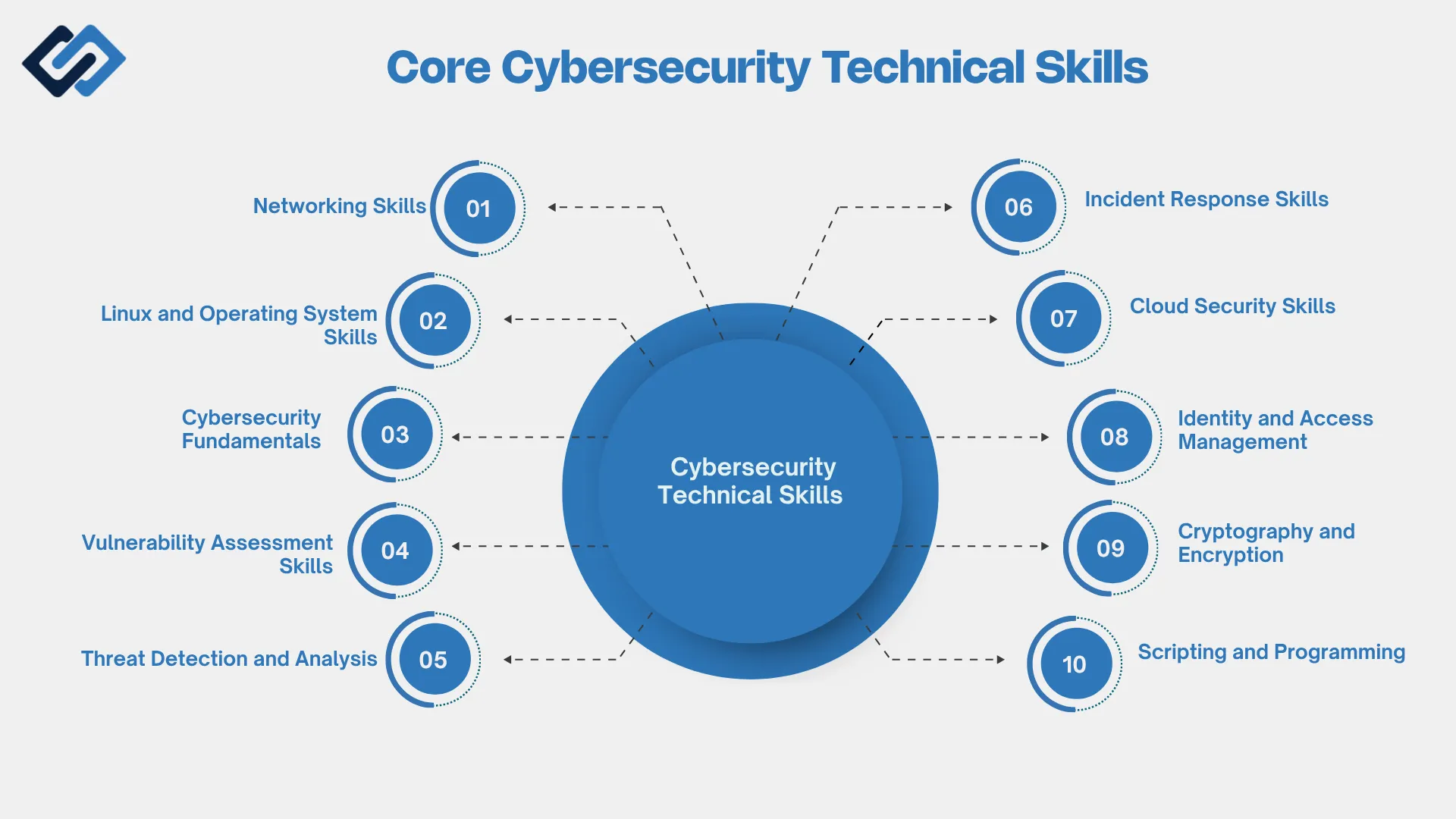
1. Networking Skills
Understanding network architecture is essential for detecting unauthorized data traffic.
TCP/IP Suite: Packet headers, three-way handshakes, routing mechanisms, and subnetting.
Core Protocols: Domain Name System (DNS), HTTP, HTTPS, Dynamic Host Configuration Protocol (DHCP), and Secure Shell (SSH).
Perimeter Controls: Firewall configuration, network segmentation rules, and Intrusion Prevention Systems (IPS).
Virtual Private Networks: Tunneling protocols, IPsec, and encrypted traffic inspection.
2. Linux and Operating System Skills
Operating system mastery provides visibility into low-level computer processes.
Linux Fundamentals: Navigation using command-line interfaces, process management, system monitoring, and bash scripting.
File System Permissions: Configuring Read, Write, and Execute rules for users, groups, and system roles.
Windows Security: Active Directory management, Group Policy Objects (GPO), registry inspection, and Windows Event Log analysis.
Services Management: Auditing background daemons, running services, and open network ports.
3. Cybersecurity Fundamentals
Core governance models dictate how security architecture is designed.
CIA Triad: Maintaining Confidentiality, Integrity, and Availability across enterprise platforms.
AAA Framework: Enforcing Authentication, Authorization, and Accounting protocols.
Access Control Models: Role-Based Access Control (RBAC) and mandatory access controls.
Security Governance: Implementing security policies, acceptable use guidelines, and operational frameworks.
4. Vulnerability Assessment Skills
Proactive security audits isolate system weaknesses before exploitation occurs.
Vulnerability Scanning: Operating automated scanning software to catalog enterprise assets and identify unpatched bugs.
Risk Evaluation: Rating security gaps using the Common Vulnerability Scoring System (CVSS).
Patch Management: Prioritizing and applying vendor updates to close software security gaps.
Prioritization: Evaluating asset criticalities against active threat intelligence.
5. Threat Detection and Analysis
Identifying active anomalies requires continuous operational visibility.
Log Analysis: Filtering syslog streams, firewall events, and authentication logs to isolate suspicious behaviors.
Indicators of Compromise: Tracking malicious file hashes, suspicious IP addresses, and rogue domain connections.
Threat Intelligence: Utilizing threat feeds to anticipate emerging attack vectors.
Anomaly Detection: Setting behavioral baselines to flag unauthorized access attempts.
To study specific attack methods, consult Types of Cyber Attacks & Threats.
6. Incident Response Skills
Structured execution minimizes damage during active security events.
Identification: Detecting unauthorized network entry or malicious process execution.
Investigation: Determining attack vector scopes, timelines, and compromised assets.
Containment: Isolating infected network segments to prevent malware propagation.
Eradication and Recovery: Removing malicious artifacts, rebuilding systems, and restoring operations from secure backups.
7. Cloud Security Skills
Securing distributed cloud architecture requires specialized configuration policies.
Cloud Infrastructure: Managing resources across AWS, Microsoft Azure, and Google Cloud Platform.
Identity Policies: Building granular Identity and Access Management (IAM) role definitions.
Data Encryption: Applying server-side and client-side encryption controls across cloud buckets.
Monitoring & Compliance: Continuous auditing of cloud security group rules and API access logs.
8. Identity and Access Management
Controlling user access rights isolates administrative privileges.
Multi-Factor Authentication: Implementing hardware tokens, authenticator apps, and passkey verifications.
Privileged Access Management: Restricting root and administrator accounts to temporary elevation windows.
Identity Governance: Automating user onboarding, role changes, and account termination processes.
9. Cryptography and Encryption
Cryptographic standards preserve sensitive data across transit and storage environments.
Symmetric vs. Asymmetric: Utilizing AES for bulk data encryption and RSA/ECC for key exchanges.
Hashing Functions: Verifying file integrity using SHA-256 and MD5 hashing algorithms.
Public Key Infrastructure: Managing SSL/TLS certificates, certification authorities, and private keys.
10. Scripting and Programming
Scripting automates repetitive auditing tasks, though advanced software development is not mandatory for all entry-level security paths.
Python: Automating API calls, parsing log files, and creating scanning scripts.
Bash: Executing operational commands and shell scripts across Linux distributions.
PowerShell: Administering enterprise Windows environments and automating Active Directory audits.
JavaScript: Analyzing client-side web application logic and cross-site scripting vulnerabilities.
Learn how to master technical software tools in Cybersecurity Tools Every Beginner Should Learn (Python, Bash & More).
Cybersecurity Soft Skills
Non-technical cybersecurity soft skills enable professionals to collaborate, analyze risk, and solve problems under pressure.
Analytical Thinking: Evaluating complex system architectures to identify obscure security oversights or subtle log anomalies.
Problem-Solving: Formulating effective workarounds during live system compromises when standard tools are unavailable.
Communication: Translating technical vulnerability metrics into clear risk briefings for business executives and board members.
Attention to Detail: Detecting minor syntax deviations, unexpected port connections, or unusual user login times during security audits.
Decision-Making: Making balanced operational choices during critical breaches to contain damage while preserving core business uptime.
Teamwork: Coordinating with software developers, network engineers, compliance officers, and executive leaders during security deployments.
Continuous Learning: Updating personal skills continuously to match evolving zero-day exploits and threat strategies.
Cybersecurity Skills by Job Role
Security expectations vary significantly across specific employment titles.
Role | Important Technical & Operational Skills | Primary Focus |
Cybersecurity Analyst | Monitoring, SIEM management, threat analysis, incident response | Monitoring event logs and handling initial incident triaging |
Cybersecurity Engineer | Network security, firewalls, cloud configuration, IAM architecture | Building and configuring defensive technical infrastructure |
Penetration Tester | Reconnaissance, vulnerability assessment, web exploits, scripting | Executing ethical hacking assessments to locate flaws |
Security Architect | Enterprise architecture, risk management, cloud security design | Designing high-level corporate security models |
Incident Responder | Digital forensics, malware analysis, log investigation, containment | Acting as first responder during corporate breach events |
Security Consultant | Risk assessment, compliance frameworks, technical communication | Advising clients on posture improvements and regulations |
Security Specialist | Security controls, monitoring, network security, patch management | Managing specific security controls across internal teams |
Cybersecurity Engineer Skills
Cybersecurity engineer skills focus heavily on security architecture design, firewall deployment, network protocol analysis, and cloud security integrations.
Cybersecurity Analyst Skills
Cybersecurity analyst skills needed to prioritize Security Information and Event Management (SIEM) operation, daily log analysis, vulnerability scanning, and incident response execution.
Penetration Tester Skills
Ethical hacking positions require advanced network security specialist skills, web security research techniques, exploit testing, and script development.
Cybersecurity Specialist Skills
A security specialist balances operational monitoring, access control management, endpoint software protection, and security policy enforcement.
For detailed employment insights, read Cybersecurity Jobs & Career Opportunities.
Skills Required for Cybersecurity Jobs
Employers look for a balanced mix of fundamental technical knowledge, practical tool experience, and communication abilities.
Networking and System Fundamentals: Hands-on command over TCP/IP protocols, Linux administration, and active directory structures.
Hands-on Tool Experience: Practical familiarity operating tools such as Wireshark, Nmap, Splunk, and Metasploit.
Verifiable Projects: Virtual laboratory documentation, GitHub script repositories, or capture-the-flag (CTF) write-ups showing practical capabilities.
Industry Certifications: Recognized credentials validating theoretical knowledge and specialized focus areas.
How to Develop Cybersecurity Skills
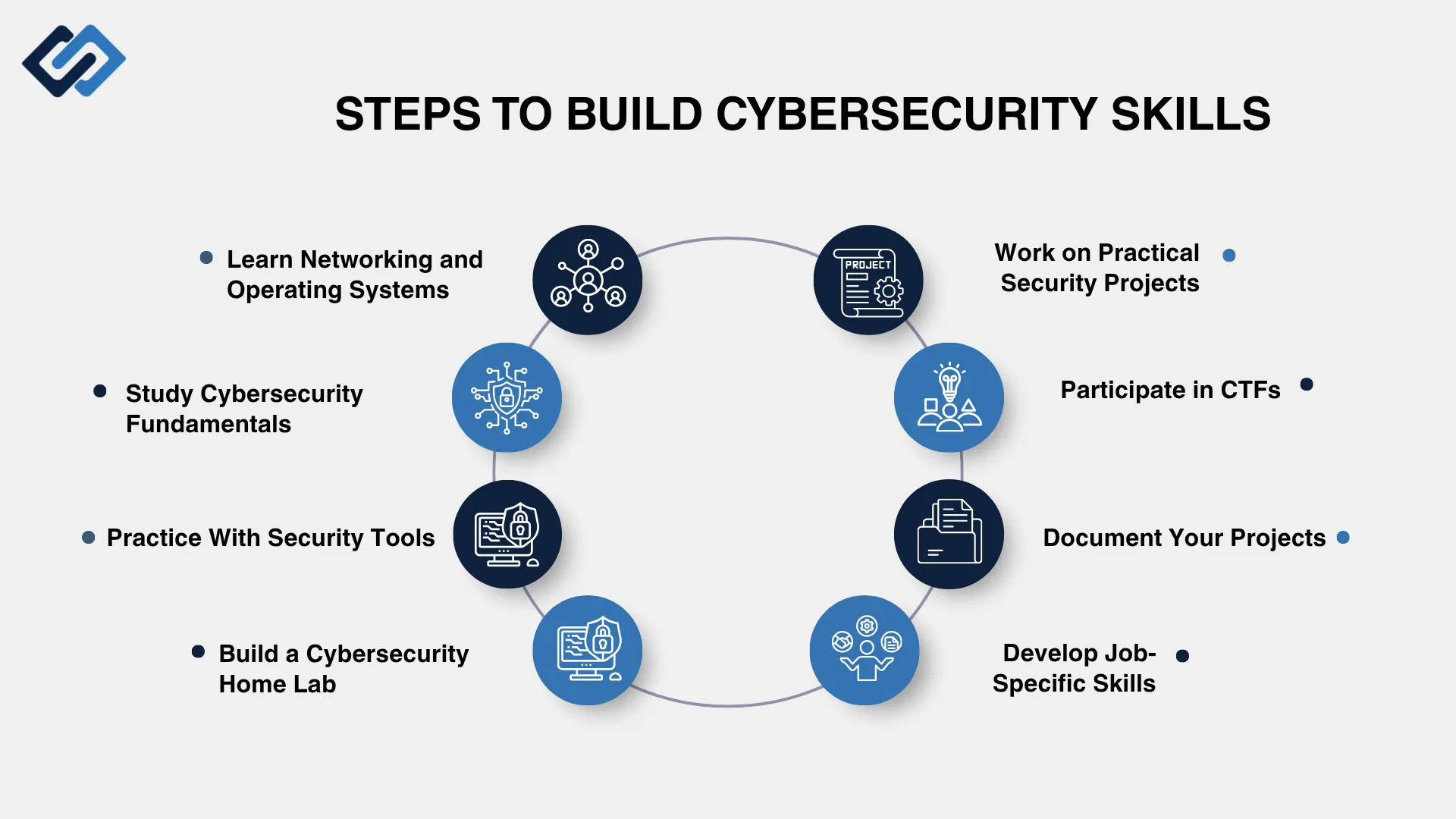
Developing cyber security jobs skills required transitions from theoretical study to practical execution.
Learn Networking and Operating Systems: Master Linux terminal navigation, Windows administration, and networking packet analysis using Wireshark.
Study Cybersecurity Fundamentals: Learn access control mechanics, cryptographic primitives, and baseline administrative security policies.
Practice With Security Tools: Install open-source security utilities to audit local traffic, scan simulated networks, and parse sample system logs.
Build a Cybersecurity Home Lab: Set up virtual environments using hypervisors to host vulnerable virtual machines alongside Kali Linux testing instances.
Work on Practical Security Projects: Write custom Python log-parser scripts, configure automated firewall rules, or perform vulnerability audits on local machines.
Participate in CTFs and Security Challenges: Utilize the best platforms for practicing cybersecurity skills for researchers and students, including platforms like TryHackMe, Hack The Box, and national CTF competitions.
Document Your Projects: Maintain public GitHub repositories and technical write-ups detailing your lab configurations and CTF problem resolutions.
Develop Job-Specific Skills: Focus your final learning modules on specific target roles, such as mastering SIEM platforms for analyst tracks or cloud IAM for engineering tracks.
Cybersecurity Skills Roadmap for Beginners
Following a structured cybersecurity skills roadmap helps streamline your professional development.
Step 1: Learn IT and Networking Fundamentals: Master TCP/IP protocols, subnetting, DNS, and hardware communication principles.
Step 2: Learn Operating Systems: Build working command-line fluency in Linux (Ubuntu, Kali) and Windows Server environments.
Step 3: Learn Cybersecurity Fundamentals: Study the CIA triad, authentication mechanisms, and core security frameworks.
Step 4: Learn Core Security Tools: Gain practical familiarity with Wireshark, Nmap, Splunk, and basic security software.
Step 5: Practice in a Cybersecurity Lab: Build isolated virtual environments to test security configurations and practice exploit mitigation safely.
Step 6: Choose a Specialization: Select a technical path such as Security Operations, Cloud Security, Penetration Testing, or Incident Response.
Step 7: Build Practical Projects: Document custom scripts, system audits, and lab configurations within a public portfolio.
Step 8: Prepare for Cybersecurity Roles: Optimize your technical resume, earn foundational certifications, and practice interview triaging.
Read our complete operational guide, to Become a Cybersecurity Professional.
The Cybersecurity Skills Gap
The global cybersecurity skills gap reflects a persistent imbalance between open digital defense roles and qualified job candidates.
Hiring Challenges: Organizations struggle to hire candidates possessing verified hands-on experience over purely academic qualifications.
Evolving Threat Dynamics: Rapid technological shifts in artificial intelligence and cloud computing require continuous workforce upskilling.
Theory vs. Practical Experience: Standard education models often focus on theoretical concepts without delivering live lab practice.
Enterprise Upskilling: Organizations are increasingly investing in internal training bootcamps and live laboratory exercises to develop technical talent internally.
How AI Is Changing Cybersecurity Skills
Artificial intelligence integration is altering the technical expectations for digital defenders.
AI-Assisted Threat Detection
Defenders leverage machine learning models to analyze millions of log events instantly and highlight anomalous network events.
AI for Security Operations
Automated playbooks ingest security telemetry, triaging low-level alerts automatically to streamline Security Operations Center workflows.
AI-Powered Attacks
Cybercriminals utilize generative AI platforms to craft hyper-personalized phishing campaigns and write dynamic malware scripts.
New Skills Cybersecurity Professionals Need
AI Literacy: Understanding machine learning operational pipelines and data integrity.
Security Automation: Writing Python and API automation routines to interact with AI platforms.
Prompt Engineering for Security: Crafting precise queries to automate log parsing and code audits.
AI Risk Assessment: Evaluating security risks associated with data poisoning and model manipulation.
Build Job-Ready Cybersecurity Skills
Developing job-ready technical expertise requires structured learning paired with real-world practical application. Commit Career offers interactive tech training programs designed to bridge the gap between theoretical knowledge and real-world execution.
Live Instructor-Led Learning: Learn directly from active security practitioners and industry experts.
Hands-on Virtual Labs: Practice defending against simulated cyber attacks in isolated environment labs.
Portfolio-Ready Projects: Build active GitHub repositories showcasing real-world security automation scripts and system audits.
Career Guidance: Receive personalized resume optimizations, capture-the-flag write-up reviews, and technical interview coaching.
Take the next step in your professional development by exploring hands-on tech training programs at Commit Career Courses today.
Are you looking to focus on a specific career pathway within cybersecurity, such as penetration testing or SOC analysis, for your next learning module?
Frequently Asked Questions About Cybersecurity Skills
What skills are needed for cybersecurity?
Cybersecurity requires a blend of technical skills (networking, Linux system administration, threat analysis, vulnerability management) and soft skills (analytical thinking, problem-solving, and communication).
What are the most important cybersecurity technical skills?
The most critical technical skills include network protocol analysis (TCP/IP), operating system administration (Linux/Windows), log monitoring (SIEM), vulnerability assessment, and cloud security configuration.
Do you need programming skills for cybersecurity?
Advanced software programming is not mandatory for all entry-level security jobs, but basic scripting in Python or Bash helps automate administrative workflows and evaluate system logs.
What skills does a cybersecurity analyst need?
Cybersecurity analysts need log inspection capabilities, SIEM management expertise, network traffic monitoring skills, threat triage abilities, and clear incident documentation skills.
What skills does a cybersecurity engineer need?
Cybersecurity engineers require deep knowledge of secure network architecture, firewall rule administration, cloud platform management, access control frameworks, and technical infrastructure deployment.
What soft skills are important in cybersecurity?
Essential soft skills include critical thinking, methodical problem-solving under pressure, clear technical communication, attention to minor log discrepancies, and adaptability.
How can beginners develop cybersecurity skills?
Beginners can build skills by studying networking fundamentals, setting up virtual home labs, practicing commands on Linux, participating in capture-the-flag challenges, and working on hands-on security projects.
How long does it take to learn cybersecurity skills?
Learning core cybersecurity fundamentals typically takes 3 to 6 months of dedicated practical study, while mastering specialized role competencies requires 12 months or more of hands-on lab practice.
What skills are required for cybersecurity jobs?
Cybersecurity jobs generally require proven proficiency in operating systems, network traffic analysis, vulnerability assessment tools, security frameworks, and technical troubleshooting.