
September 2, 2026 · Asmit Adhikari
What Is Cybersecurity? Beginner's Guide to Types, Threats & Careers (2026)
On this page
Cybersecurity is the practice of protecting systems, networks, devices, and data from digital attacks, unauthorized access, and malicious damage. As organizations rely more on digital operations, enrolling in accredited tech programs helps aspiring tech professionals build high-demand skills. Learners globally can access specialized career training tailored to regional markets in the USA, the UK, Canada, and Australia.
What Is Cybersecurity?
Cybersecurity refers to the technologies, processes, and policies designed to protect computer systems, networks, software applications, and sensitive data from cyber threats. The overall cybersecurity meaning centers on maintaining operational continuity, safeguarding private communications, and preventing digital theft.
Cybersecurity in Simple Terms
In everyday life, cybersecurity acts like a digital home security system. Just as physical locks, alarm systems, and security cameras protect a house from physical break-ins, cybersecurity uses passwords, encryption, firewalls, and monitoring tools to protect digital information from unauthorized access.
What Does Cybersecurity Protect?
Personal Information: Social Security numbers, bank details, healthcare records, and home addresses.
Business Data: Trade secrets, financial statements, customer databases, and proprietary source code.
Devices and Endpoints: Laptops, smartphones, servers, tablets, and IoT appliances.
Networks: Internal corporate networks, public Wi-Fi access points, and telecommunications infrastructure.
Applications: Web platforms, mobile apps, databases, and enterprise software.
Cloud Systems: Hosted infrastructure, cloud storage buckets, and virtual servers.
Digital Identities: User logins, biometric access controls, and multi-factor authentication credentials.
Why Is Cybersecurity Important?
Modern society depends entirely on connected systems to run power grids, financial institutions, hospitals, and supply chains. Weak security practices leave critical operations exposed to cyber risks that lead to severe disruption.
According to data published by the U.S. Bureau of Labor Statistics, the economic impact of cyber breaches continues to fuel rapid hiring across every major sector.
Data Breaches: Unauthorized entry into corporate networks exposes sensitive customer and employee records.
Financial Losses: Direct expenses stem from ransom payments, system repairs, legal representation, and regulatory compliance penalties.
Identity Theft: Stolen personal records allow cybercriminals to commit financial fraud under victim identities.
Business Disruption: Ransomware and distributed attacks lock employees out of operational software and halt production line activities.
Privacy Protection: Effective security safeguards individual rights by keeping confidential conversations and personal files private.
Reputation Damage: Organizations experiencing a public cybersecurity breach often lose consumer trust and enterprise valuation.
Critical Infrastructure Protection: Defending power plants, water treatment facilities, and transportation networks prevents real-world public safety crises.
How Does Cybersecurity Work?
Cybersecurity functions through a structured lifecycle that helps organizations systematically manage digital risk. The widely adopted NIST Cybersecurity Framework 2.0 outlines these core operational stages.
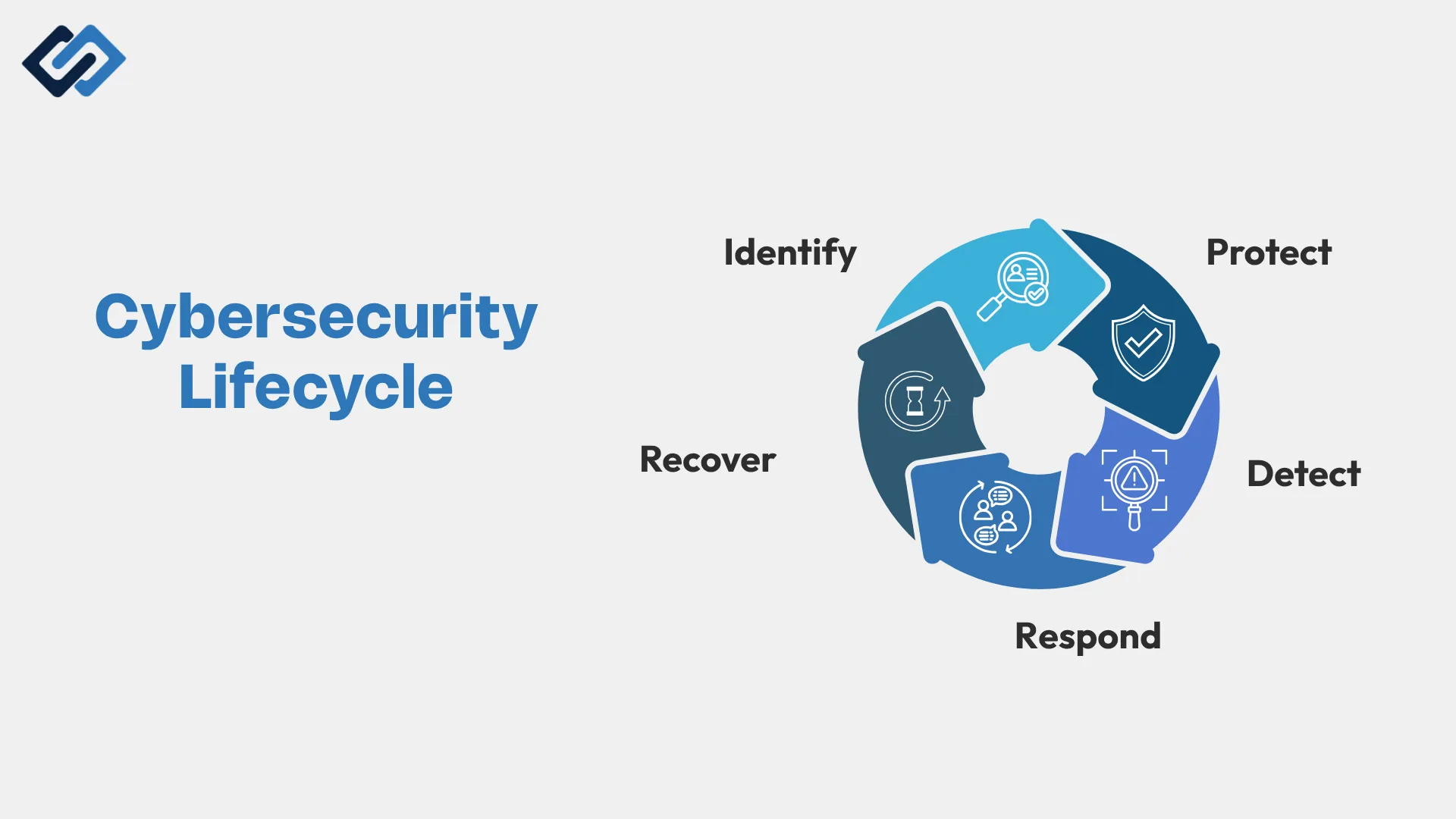
Identify: Organizations audit their technical ecosystem to catalogue physical hardware, software applications, data repositories, and potential attack vectors.
Protect: Defenders implement proactive safeguards such as strict access controls, data encryption, network segmentation, and mandatory employee awareness policies.
Detect: Continuous monitoring systems analyze network traffic and system logs in real time to flag anomalous activities or active indicators of compromise.
Respond: When a security event occurs, security teams contain affected environments, eradicate malicious files, and notify impacted stakeholders.
Recover: Incident response teams restore compromised databases from isolated backups, repair damaged software, and refine defensive procedures to prevent recurring attacks.
What Are the Main Types of Cybersecurity?
Organizations deploy specialized defensive fields to safeguard distinct layers of their technological environment.
Network Security: Secures internal corporate networks, routers, and wireless access points against unauthorized monitoring, intrusion, or data interception.
Application Security: Focuses on writing secure code, patching software vulnerabilities, and implementing firewalls during the development phase of web and mobile software.
Cloud Security: Safeguards public, private, and hybrid cloud infrastructure, ensuring data hosted on platform providers remains isolated and encrypted.
Endpoint Security: Protects individual hardware devices (workstations, smartphones, and servers) connected to corporate infrastructure against endpoint infections.
Information Security: Enforces strict confidentiality, integrity, and availability controls to protect sensitive physical and digital data regardless of where it is stored.
Identity and Access Management: Controls permissions, enforcing least-privilege policies to verify user identities before granting system entry.
Critical Infrastructure Security: Safeguards physical and digital infrastructure vital to public safety, including energy grids, telecommunications networks, and municipal water plants.
AI Security: Defends artificial intelligence pipelines and machine learning models against data poisoning, adversarial attacks, and unauthorized model manipulation.
What Are the Most Common Cybersecurity Threats?
Cyberattacks evolve constantly as bad actors deploy increasingly sophisticated attack vectors. Beginners can review our detailed analysis of types of cyber attacks & threats explained to learn about specific threat mechanics.
Malware: Malicious software designed to damage, exploit, or disable computers and systems. Common types include computer viruses, worms, and Trojans.
Ransomware: Extortion malware that encrypts victim files, demanding payment in exchange for the decryption key.
Phishing and Social Engineering: Deceptive communication tactics designed to trick individuals into disclosing sensitive passwords, financial credentials, or confidential tokens.
Credential Theft: Stealing user access tokens through brute-force attempts, credential stuffing attacks, or keylogging programs.
Insider Threats: Security risks originating from within the targeted organization, including malicious employees or negligent contractors.
Denial-of-Service and DDoS Attacks: Flooding targeted servers or network infrastructure with artificial internet traffic to disrupt normal service availability.
Zero-Day Vulnerabilities: Exploits targeting software flaws that are unknown to the developer and lack an official vendor security patch.
Supply Chain Attacks: Targeting third-party software vendors or service providers to gain unauthorized access to primary enterprise networks downstream.
AI-Powered Cyberattacks: Automated attack vectors utilizing machine learning algorithms to generate realistic phishing material and dynamically evade antivirus scanners.
What Are Cybersecurity Vulnerabilities and Risks?
Understanding how weaknesses transform into enterprise damage requires distinguishing between threats, vulnerabilities, and overall risks.
What Is a Cybersecurity Vulnerability?
A cybersecurity vulnerability is a design flaw, system misconfiguration, or unpatched software bug that provides unauthorized entry to malicious actors.
What Is a Cybersecurity Risk?
Cybersecurity risk measures the potential loss, financial impact, or operational damage that occurs when a threat actor successfully exploits a system vulnerability.
Vulnerability vs Threat vs Risk
Term | Simple Meaning | Real-World Example |
Threat | A potential source of harm or attack | An external cybercriminal seeking financial gain |
Vulnerability | A weakness or security gap in a system | Outdated web server software with known security flaws |
Risk | The impact of a threat exploiting a vulnerability | Potential customer data theft leading to regulatory fines |
How Organizations Manage Cybersecurity Risks
Risk Identification: Scanning networks to log digital assets and locate known system flaws.
Risk Analysis: Calculating the likelihood of an attack against the operational impact of system downtime.
Risk Mitigation: Applying software patches, strengthening passwords, and installing firewalls to minimize attack surfaces.
Risk Transfer: Purchasing cybersecurity insurance policies to offset financial liabilities.
Cybersecurity Frameworks and Standards
Frameworks provide structured blueprints that help organizations align security operations with international compliance standards.
NIST Cybersecurity Framework: Developed by the National Institute of Standards and Technology, this baseline framework helps public and private organizations manage cybersecurity risk effectively.
ISO/IEC 27001: An international standard that mandates guidelines for establishing, implementing, maintaining, and continually improving an Information Security Management System (ISMS).
CIS Controls: A prioritized set of actionable defensive actions designed by the Center for Internet Security to mitigate common cyberattacks.
Zero Trust Security: A strategic architecture operating on a strict principle: "Never trust, always verify." Every user and device must authenticate continuously regardless of network location.
Cybersecurity Tools and Technologies
Defenders rely on technical tools to inspect traffic, audit configurations, and block malicious activity. Learn hands-on application strategies in our guide on cybersecurity skills & tools.
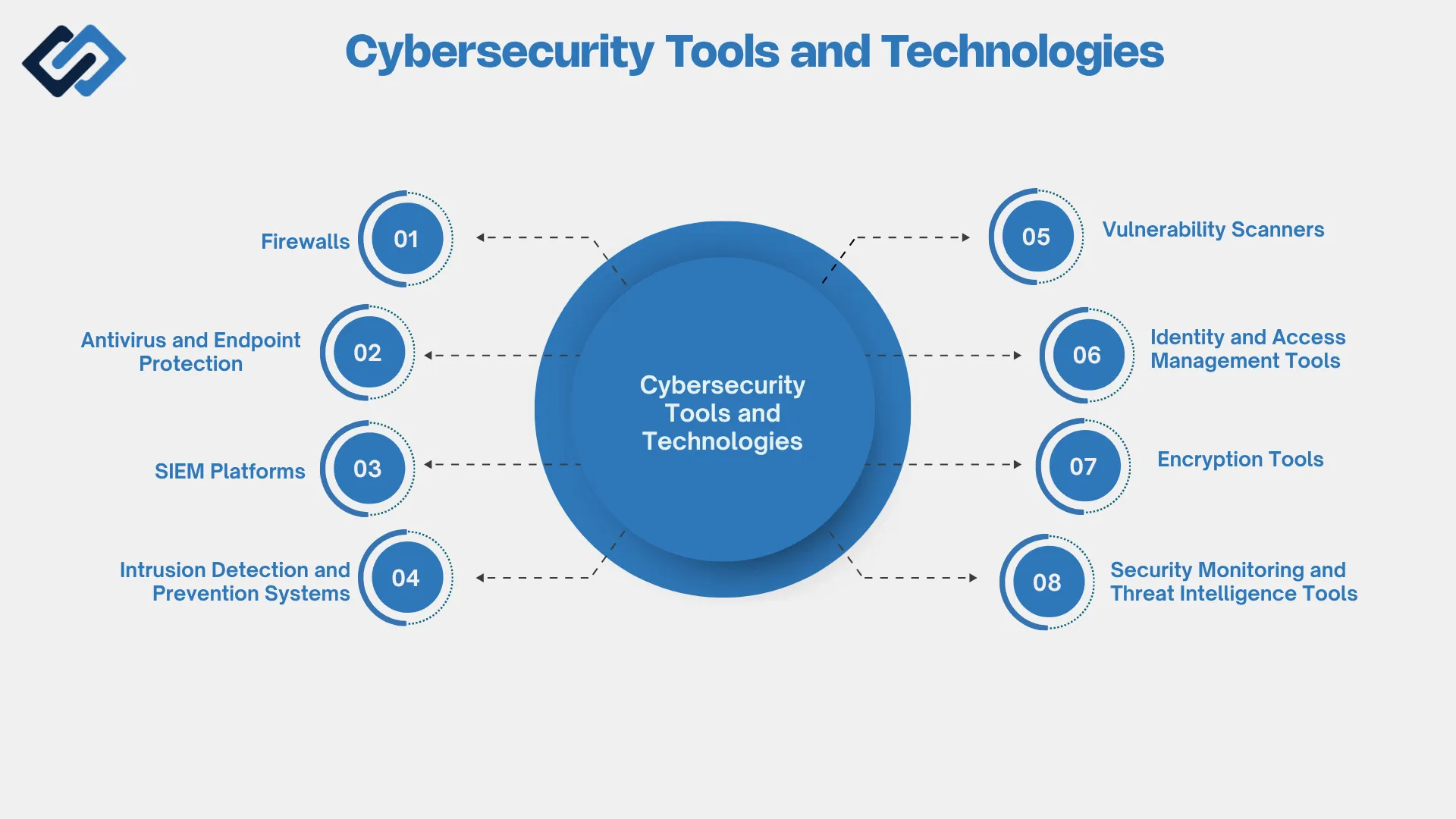
Firewalls: Hardware or software systems that monitor incoming and outgoing network traffic based on predefined security rules.
Antivirus and Endpoint Protection: Programs that scan local devices for known malware signatures and monitor real-world system behavior for anomalous activity.
SIEM Platforms: Security Information and Event Management systems collect, analyze, and aggregate log data across enterprise networks to flag security incidents.
Intrusion Detection and Prevention Systems: IDPS platforms continuously inspect network traffic to identify suspicious signatures and block unauthorized network intrusion attempts automatically.
Vulnerability Scanners: Automated tools that inspect software configurations, ports, and applications to highlight unpatched security vulnerabilities.
Identity and Access Management Tools: Software platforms managing user roles, enforcing strict password complexity, and handling single sign-on (SSO) authentication.
Encryption Tools: Cryptographic software that scrambles plain text into unreadable ciphertext to keep data secure during transit and storage.
Security Monitoring and Threat Intelligence Tools: Feeds and platforms that aggregate real-world data on emerging threat vectors, global hacking groups, and malware signatures.
Cybersecurity and Artificial Intelligence: What Is Changing?
Artificial intelligence is reshaping digital security operations. Explore deeper career implications in our analysis of ai in cybersecurity.
How AI Is Used in Cybersecurity
Automated Threat Detection: Machine learning algorithms evaluate millions of network events every second to spot unusual behavior.
Anomaly Detection: AI establishes baseline user behavioral profiles to instantly flag access requests from unexpected geographic locations.
Automated Incident Response: Intelligent scripts automatically isolate infected network hosts before malware spreads across corporate networks.
Malware Analysis: Predictive models analyze novel malware samples based on binary execution behaviors rather than static code signatures.
Security Operations Center Automation: AI assists analysts by filtering false-positive security alerts, allowing teams to prioritize critical threats.
How Attackers Are Using AI
Convincing Phishing Campaigns: Generative AI models draft natural, hyper-personalized spear-phishing emails free from grammar errors.
Automated Vulnerability Discovery: Malicious scripts scan source code repositories autonomously to locate unpatched software bugs.
Deepfakes and Impersonation: Synthetic audio and video clone executive voices to authorize fraudulent wire transfers.
Faster Attack Execution: AI scripts adapt execution techniques dynamically to bypass static endpoint security software.
The Future of AI and Cybersecurity
The defensive landscape is moving toward continuous, automated machine-versus-machine security battles. Success requires human security analysts who can oversee AI monitoring engines while managing overarching strategic defenses.
Cybersecurity Best Practices
Implementing standard baseline controls mitigates the overwhelming majority of common cyber threats.
Use Strong Passwords and Multi-Factor Authentication: Create unique, complex passwords for every account using password managers, and mandate Multi-Factor Authentication (MFA) across all digital portals.
Keep Software and Systems Updated: Apply vendor security patches promptly to eliminate software vulnerabilities before cybercriminals exploit them.
Encrypt Sensitive Data: Enforce full-disk encryption on laptops and mandate HTTPS/TLS transport encryption for all web communications handling sensitive data.
Back Up Important Data: Maintain regular offline or immutable cloud backups using the 3-2-1 rule: three copies of data on two different media types with one stored offsite.
Train Employees to Recognize Threats: Conduct continuous security awareness training and simulated phishing campaigns to educate workforce members on social engineering tactics.
Apply Least-Privilege Access: Limit account access rights strictly to the minimum resources required for an employee to complete daily job duties.
Monitor Systems and Networks: Deploy central logging tools to capture system activities, facilitating rapid forensic audits when anomalous behavior occurs.
Create an Incident Response Plan: Document exact step-by-step procedures for containing breaches, restoring operational servers, notifying authorities, and communicating with customers during a breach.
Essential Cybersecurity Skills
Building a career in cybersecurity requires mastering both technical tools and interpersonal professional capabilities.
Technical Cybersecurity Skills
Networking Fundamentals: TCP/IP protocols, DNS, subnetting, and network routing mechanisms.
Operating Systems: Advanced Linux administration and Windows Server management.
Cloud Security Configuration: Managing security groups across AWS, Azure, or Google Cloud environments.
Security Tools Operations: Proficiency with Wireshark, Nmap, Splunk, and Metasploit.
Vulnerability Assessment: Running security auditing tools to assess enterprise software posture.
Cryptography: Understanding public/private key pairs, hashing functions, and digital certificates.
Incident Response Procedures: Containing live network compromises and analyzing system logs.
Scripting and Programming: Automating repetitive security tasks using Python, Bash, or PowerShell.
Professional Skills
Analytical Thinking: Evaluating complex system architecture diagrams to locate subtle security flaws.
Problem-Solving: Developing creative workarounds when remediating live network compromises under tight deadlines.
Communication: Explaining technical security vulnerabilities clearly to non-technical business leaders.
Attention to Detail: Noticing minor log discrepancies that indicate initial network intrusion attempts.
Risk Assessment: Balancing business operational needs against necessary technical security controls.
Can Cybersecurity Professionals Work Remotely?
Yes, cybersecurity offers extensive work-from-home options. Cloud-native monitoring software and remote access portals allow security engineers, threat analysts, and consultants to manage enterprise security remotely.
compensation trends detailed in our cybersecurity salary guide reveal that remote security roles command high salaries comparable to traditional office-based positions.
Cybersecurity Career Path: How to Get Started
Breaking into cybersecurity requires a practical, step-by-step approach. Follow our dedicated guide to become a cybersecurity professional for complete operational guidance.
Learn Cybersecurity Fundamentals: Build core knowledge around network protocols, computer hardware, operating system mechanics, and basic security principles.
Build Networking and Linux Skills: Master command-line interfaces in Linux distributions (Ubuntu, Kali) and understand how data packets navigate network switches, firewalls, and routers.
Learn Security Tools: Gain practical experience using open-source tools such as Wireshark for network packet analysis, Nmap for port scanning, and Burp Suite for application security audits.
Practice in Labs and Projects: Apply technical skills within safe virtual lab environments like TryHackMe, Hack The Box, or custom virtual machine setups.
Build a Cybersecurity Portfolio: Document personal hands-on projects, write-ups of completed capture-the-flag (CTF) challenges, and script repositories on platforms like GitHub to demonstrate practical expertise to employers.
Consider Certifications or a Cybersecurity Bootcamp: Validate skills through entry credentials such as CompTIA Security+ or structured training programs. Review our evaluation of the best cybersecurity certifications to choose the best credential path.
Apply for Entry-Level Cybersecurity Roles: Target positions such as Junior SOC Analyst, IT Security Assistant, or Help Desk Specialist to break into the industry. Review strategies in our guide to cybersecurity careers.
Who Should Learn Cybersecurity?
Students and Beginners: High school graduates or university students looking to enter a fast-growing tech field.
IT Professionals: System administrators, network technicians, and help desk specialists seeking higher-paying technical roles.
Career Changers: Professionals transitioning from non-technical careers who possess strong analytical and problem-solving skills.
Business Owners and Managers: Entrepreneurs needing to protect proprietary customer data, prevent ransomware disruptions, and meet industry compliance mandates.
What Happens When Cybersecurity Fails?
Exposing security gaps causes immediate and cascading real-world damage across organizational operations.
Data Can Be Exposed or Stolen: Confidential employee profiles, customer credit card records, and proprietary operational secrets fall into malicious hands, leading to permanent competitive loss.
Systems and Services Can Be Disrupted: Ransomware locks operational file systems, while DDoS attacks knock consumer websites offline, halting sales and internal communications.
Organizations Can Face Financial Losses: According to the U.S. Bureau of Labor Statistics, recovery costs, legal representation fees, emergency technical consulting, and compliance fines accumulate rapidly during breaches.
Customers and Employees Can Be Put at Risk: Exposed personal data leads directly to identity fraud, phishing scams, and unauthorized financial transactions targeting individuals.
Cyber Incidents Can Damage Trust: Losing client data destroys brand equity, causing customers, institutional investors, and business partners to migrate to secure competitors.
Cybersecurity Trends to Watch
AI-Powered Attacks and Defense: Widespread integration of artificial intelligence across defensive SOC tools and offensive exploit development.
Zero Trust Acceleration: Replacing traditional perimeter network security models with identity-based, continuous authentication architectures.
Cloud Security Standardization: Enterprise cloud adoption makes securing cloud containers, APIs, and multi-cloud environments a primary operational priority.
Identity-First Security: Prioritizing centralized access management, biometric checks, and passkey technologies over traditional passwords.
Security Automation: Deploying automated playbook tools to execute immediate incident containment without waiting for human analyst intervention.
Growing Cybersecurity Skills Gap: Broad demand ensures strong employment stability for professionals holding verified practical technical skills.
Increasing Regulatory and Privacy Requirements: Strict global consumer privacy mandates force corporations to invest heavily in data protection compliance.
Cybersecurity Terms Every Beginner Should Know
Term | Simple Definition |
Malware | Malicious software created specifically to infect, damage, or exploit systems. |
Phishing | Fraudulent communications designed to trick victims into revealing sensitive credentials. |
Firewall | A security system that monitors and filters incoming and outgoing network traffic. |
Encryption | The process of scrambling plain text data into unreadable ciphertext to prevent unauthorized reading. |
MFA | Multi-Factor Authentication; requiring two or more identity verification steps for system access. |
VPN | Virtual Private Network; creates an encrypted internet connection over public networks. |
Vulnerability | A system weakness or software bug that attackers can exploit to gain unauthorized access. |
Zero-Day | A software security vulnerability that is actively exploited before developers create a patch. |
Ransomware | Extortion malware that encrypts files and demands payment to restore operational access. |
SIEM | Security Information and Event Management; a central platform analyzing enterprise log data. |
Start Your Cybersecurity Journey
Transitioning into cybersecurity begins with building verified, practical skills that align with real-world enterprise requirements.
Who Training Is For: Aspiring tech professionals, career changers, IT support specialists, and students seeking to enter high-growth technology fields.
What You Will Learn: Practical network security, operating system administration, security tool configuration, vulnerability analysis, and incident response fundamentals.
Hands-on Practice: Real-world virtual lab exercises simulating actual network intrusion scenarios, threat analysis workflows, and enterprise log audits.
Career Preparation: Focused portfolio development, resume optimizations, capture-the-flag challenge write-ups, and technical interview coaching.
Portfolio & Projects: Build active GitHub repositories demonstrating security automation scripts, system configurations, and network security audits to present directly to prospective employers.
Take the next step in your professional development by exploring hands-on tech training programs at Commit Career Courses today.
Are you looking to focus on a specific career pathway within cybersecurity, such as penetration testing or SOC analysis, for your next learning module?
Frequently Asked Questions.
What is cybersecurity?
Cybersecurity is the practice of protecting computer systems, networks, devices, and digital data from unauthorized access, cyberattacks, theft, and malicious damage.
What are the 5 main types of cybersecurity?
The core types of cybersecurity include Network Security, Application Security, Cloud Security, Endpoint Security, and Information Security.
Why is cybersecurity important?
Cybersecurity protects sensitive personal information, prevents enterprise financial losses, safeguards critical national infrastructure, and maintains business continuity against cyber threats.
What are the most common cybersecurity threats?
Common cybersecurity threats include malware infections, ransomware extortion, phishing scams, credential theft, denial-of-service attacks, and unpatched software vulnerabilities.
What skills do you need for cybersecurity?
Key cybersecurity skills include networking fundamentals, Linux command-line operations, security tool management, basic scripting (Python or Bash), vulnerability scanning, and analytical problem-solving.
Is cybersecurity difficult to learn?
Cybersecurity requires learning technical concepts like networking and system administration, but beginners can master it through structured study, practical virtual labs, and hands-on practice.
Can I learn cybersecurity with no experience?
Yes, beginners without prior IT experience can learn cybersecurity by mastering foundational computing concepts, studying core networking principles, and building practical skills through virtual lab environments.
Is cybersecurity a good career?
Yes, cybersecurity offers high job demand, excellent entry-level compensation, rapid salary advancement, and broad opportunities for remote work due to global industry talent shortages.
What does a cybersecurity engineer do?
A cybersecurity engineer designs, builds, configures, and maintains an organization's security infrastructure, including firewalls, security software platforms, network monitoring systems, and data encryption controls.
Can cybersecurity jobs be remote?
Yes, many cybersecurity positions, including Security Analysts, Security Engineers, and Cybersecurity Consultants, offer remote work options because systems can be monitored securely over cloud networks.
What is a cybersecurity roadmap for beginners?
A beginner cybersecurity roadmap involves mastering fundamental IT concepts, learning Linux and networking basics, practicing with security tools in virtual labs, building a project portfolio, earning certifications, and applying for entry-level SOC or support roles.
Is AI changing cybersecurity?
Yes, artificial intelligence is transforming cybersecurity by automating real-time threat detection, speeding up log analysis, and enabling security teams to isolate infected hosts automatically, while also giving attackers tools to craft automated phishing campaigns.