
September 6, 2026 · Dhiraj Bashyal
Data Science Skills and Tools: Complete Guide for Beginners in 2026
On this page
Data science combines statistical analysis, programming, and domain expertise to extract actionable insights from complex datasets. As organizations generate multi-terabyte databases daily, knowing the exact data science skills and data science tools required by global employers is essential for building a high-growth tech career. Whether you plan to work locally or target remote international opportunities, following a structured learning plan will save you hundreds of hours of unfocused study.
Ready to accelerate your technical training with industry mentorship? Start building job-ready skills today through our comprehensive online IT courses.
Quick Summary: Essential Data Science Skill Set
Skill Category | Core Competency | Primary Tools & Technologies |
Foundational Tech | Database Querying & Scripting | Python, SQL, Git |
Mathematics | Applied Statistics & Linear Algebra | Probability, Hypothesis Testing, Matrix Ops |
Data Handling | Cleaning, Wrangling & EDA | pandas, NumPy, SQL |
Visualization | Business Dashboards & Storytelling | Tableau, Power BI, Matplotlib, Seaborn |
Machine Learning | Predictive Modeling & Evaluation | scikit-learn, XGBoost |
Advanced / MLOps | Model Deployment & Cloud Systems | Docker, FastAPI, AWS, PyTorch |
What Are Data Science Skills?
Data science skills represent the combined technical competencies, mathematical knowledge, and soft skills required to analyze complex data, build predictive algorithms, and communicate data-driven decisions.
Technical Skills vs. Soft Skills
Technical Skills: Hard engineering and mathematical capabilities, such as writing SQL queries, building regression models in Python, or configuring cloud deployments.
Soft Skills: Interpersonal and cognitive abilities, including critical thinking, clear communication, and understanding business operations.
The Complete Data Science Skill Set
A complete data science skills set balances three foundational pillars:
Computer Science & Software Development: Writing clean, scalable Python and SQL code.
Mathematics & Statistics: Validating models and understanding algorithm mechanics.
Business Acumen & Communication: Translating statistical outputs into actionable corporate strategy.
Data Science Skills vs. Data Analytics Skills
Data analytics focuses primarily on describing historical trends to answer past business questions (determining what happened). Data science extends beyond descriptive analysis by using advanced statistics and machine learning to build automated systems that forecast future outcomes (determining what will happen next).
Why Are Data Science Skills Important?
Modern organizations rely on quantitative metrics rather than intuition to make executive decisions.
Data-Driven Decision Making: Companies deploy data models to optimize supply chains, predict customer churn, and personalize user recommendations.
Employer Value: Candidates who can clean messy enterprise data and turn it into financial savings or revenue growth command premium salaries globally.
The AI Landscape: Artificial Intelligence tools accelerate basic code generation, but human data professionals remain necessary to validate model outputs, prevent algorithmic bias, and align technical systems with strategic business targets.
Hybrid Skill Demand: Combining deep technical capabilities with strategic business communication makes data professionals indispensable key partners to executive leadership.
Core Data Science Technical Skills
Mastering core data science technical skills requires systematic practice across mathematical frameworks, programming environments, and production systems.
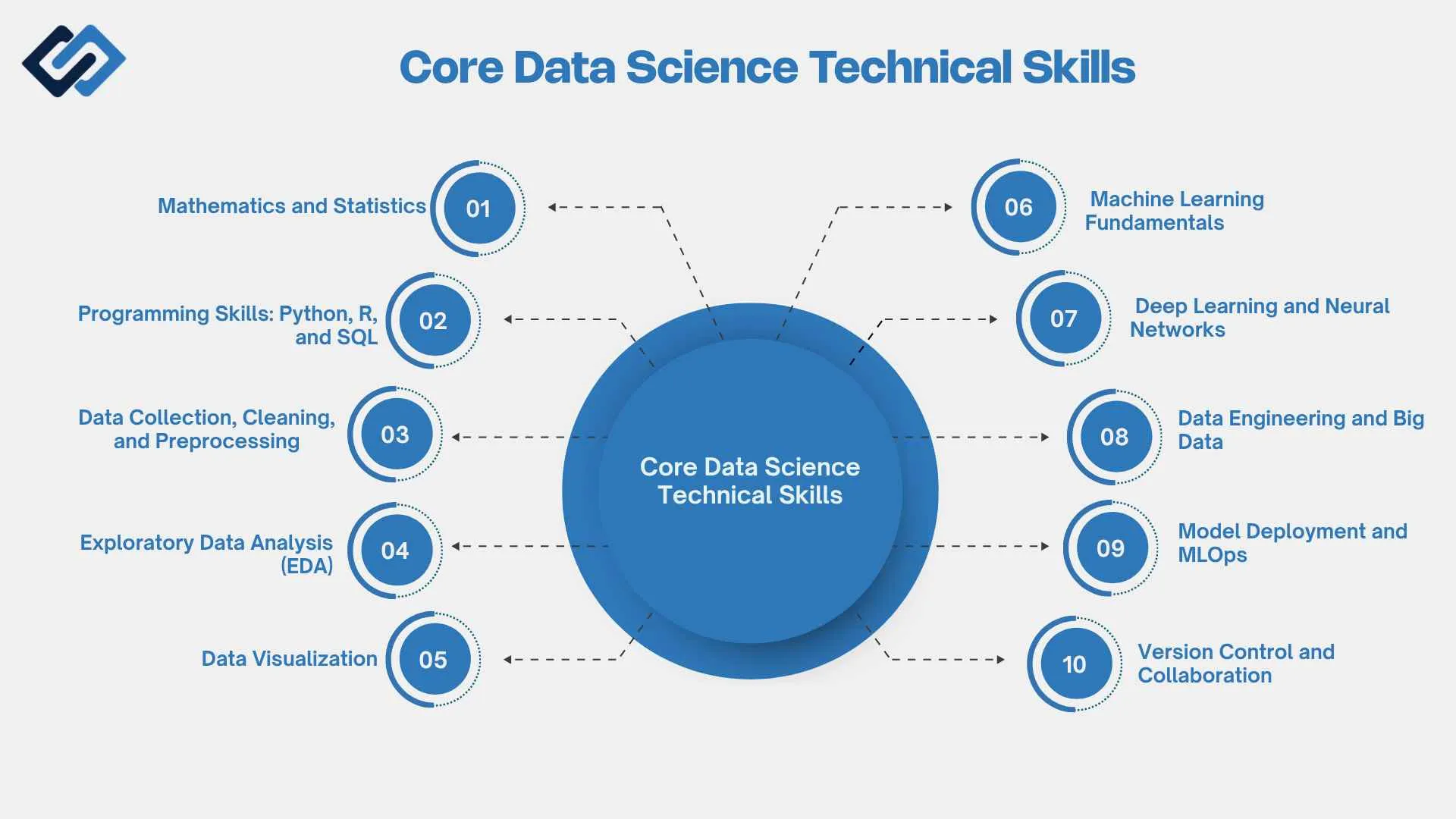
1. Mathematics and Statistics
To build reliable models, you need functional data science math skills that govern algorithm behavior:
Probability: Bayes' theorem, conditional probability, and discrete or continuous distributions.
Statistics: Descriptive metrics (mean, variance, standard deviation) and inferential analytics.
Hypothesis Testing: Defining Null ($H_0$) and Alternative ($H_1$) hypotheses, calculating $p$-values, setting significance thresholds ($\alpha$), and executing t-tests or ANOVA calculations.
Regression: Linear and polynomial modeling to identify variable correlations.
Linear Algebra: Vector spaces, matrix transformations, dot products, and eigenvalues for dimensionality reduction and neural networks.
Calculus & Optimization: Derivatives, partial derivatives, and gradient descent algorithms.
What level of math do beginners actually need? You do not need a theoretical pure mathematics degree. Focus on applied statistics, basic linear algebra operations, and derivative calculus to understand how machine learning models optimize their loss functions.
2. Programming Skills: Python, R, and SQL
Writing modular code is essential for extracting and manipulating raw data.
Python: The universal primary language for machine learning, automation, and general data processing.
R: An ideal language for academic research, specialized quantitative finance, and complex statistical computing.
SQL: The essential industry standard for database querying, joining relational tables, and extracting multi-terabyte corporate datasets.
When evaluating data analysis tools sql scripts handle database retrieval, while data analytics tools r and Python scripts handle down-stream processing, statistical modeling, and machine learning pipelines. Beginners should master Python and SQL first before exploring supplementary options like R.
3. Data Collection, Cleaning, and Preprocessing
Data cleaning and preparation consume up to 80% of a working data professional's time.
Data Sources: Ingesting structured tables, unstructured JSON APIs, and CSV files.
Missing Values & Duplicates: Imputing missing values safely and deduplicating record sets.
Outlier Treatment: Detecting anomalies using z-scores or Interquartile Ranges (IQR).
Feature Engineering: Encoding categorical variables (One-Hot Encoding) and normalizing numerical features using standard scaling.
4. Exploratory Data Analysis (EDA)
EDA involves summarizing main dataset characteristics through visual and quantitative methods. It helps you discover patterns, detect anomalies, test early hypotheses, and check assumptions before training machine learning models.
5. Data Visualization
Converting complex mathematical relationships into intuitive visuals is a core data science essential skills requirement.
Core Principles: Select clean visual design layouts that emphasize core data insights without adding chart clutter.
Selecting Charts: Matching line charts for trends, bar graphs for categorical comparisons, and scatter plots for numerical correlations.
Interactive Visuals & Dashboards: Building dynamic web-ready reports that let stakeholders filter metrics dynamically.
Effective data science visualization tools bridge the gap between technical data engineering and non-technical management teams.
6. Machine Learning Fundamentals
Machine learning trains statistical models on historical data to predict future outputs.
Supervised Learning: Training models on labeled targets via Regression (predicting continuous values) and Classification (predicting discrete labels).
Unsupervised Learning: Identifying inherent groupings in unlabeled data via K-Means Clustering or Principal Component Analysis (PCA).
Model Evaluation: Measuring precision, recall, F1-score, and Mean Absolute Error (MAE).
Overfitting & Underfitting: Balancing model complexity so algorithms generalize well to unseen test data.
7. Deep Learning and Neural Networks
Deep learning uses multi-layer neural network architectures inspired by biological cognitive frameworks.
Use Cases: Recommended for high-dimensional, unstructured data including computer vision, speech recognition, and natural language processing (NLP).
Architectures: Convolutional Neural Networks (CNNs) for image processing and Transformer models for large language applications.
Note for Beginners: Master standard machine learning algorithms like Random Forests and XGBoost on structured tabular data before studying deep learning frameworks.
8. Data Engineering and Big Data
Data scientists must understand how data moves through enterprise pipelines.
ETL/ELT: Extracting, Transforming, and Loading data across environments.
Data Warehouses & Lakes: Managing centralized cloud storage repositories.
Distributed Computing: Leveraging Apache Spark and Databricks to process multi-gigabyte datasets across distributed computing clusters.
9. Model Deployment and MLOps
A model sitting inside a Jupyter notebook brings zero operational value to a business until it is deployed into production.
API Creation: Wrapping trained models inside REST APIs using FastAPI or Flask.
Containerization: Packaging code dependencies cleanly using Docker containers.
MLOps Fundamentals: Continuous integration and continuous deployment (CI/CD) pipelines, model latency monitoring, and automated retraining workflows.
10. Version Control and Collaboration
Modern data science is a team effort. Learning Git and GitHub allows you to track code changes, collaborate with software developers through pull requests, and maintain clean public code documentation.
Essential Data Science Tools
Navigating the landscape of modern data science tools is much easier when you organize them by operational category.
Category | Primary Tools | Typical Use Case |
Programming Environments | Python, R, Jupyter Notebook, VS Code | Writing scripts, interactive testing, and application development. |
Data Analysis & Wrangling | pandas, NumPy, SQL, R tidyverse | Ingesting tabular files, aggregating metrics, and vectorized operations. |
Data Visualization | Matplotlib, Seaborn, Plotly, ggplot2 | Rendering static statistical graphs and interactive web graphics. |
Business Intelligence | Power BI, Tableau | Building enterprise executive dashboards and reporting views. |
Machine Learning | scikit-learn, XGBoost, LightGBM, PyTorch | Building predictive tabular models, gradient boosting, and neural networks. |
Big Data Engineering | Apache Spark, Databricks, Apache Airflow | Running distributed computations and orchestrating automated data pipelines. |
Cloud & MLOps | AWS, Azure, Google Cloud, Docker, MLflow | Hosting models in cloud infrastructure, containerizing code, and tracking experiments. |
Data Science Soft Skills
Technical proficiency gets you an interview, but data science soft skills land you the job and drive long-term career progression.
Analytical Thinking: Breaking complex, ambiguous operational problems into structured, solvable analytical steps.
Problem-Solving: Formulating clear hypothesis frameworks when datasets are incomplete or messy.
Communication: Explaining statistical trade-offs, confidence intervals, and algorithm limitations to executive stakeholders clearly.
Business Understanding: Connecting modeling performance directly to metrics like profit margin, customer retention, or operational costs.
Data Storytelling: Building narrative structures around visual charts to guide executive team strategies.
Collaboration and Teamwork: Partnering effectively with data engineers, software development teams, and product managers.
Curiosity & Continuous Learning: Staying up to date with continuous advancements across generative AI, open-source libraries, and MLOps tools.
Most In-Demand Data Science Skills in 2026
Modern job listings prioritize candidate proficiency in a lean, execution-focused stack:
Python & SQL Mastery: Writing clean, scalable, object-oriented code and complex relational database queries.
Applied Statistics & A/B Testing: Validating experimental outcomes objectively.
Production Machine Learning: Deploying scikit-learn and XGBoost pipelines to solve real business tasks.
Cloud & MLOps Integration: Managing containers via Docker and deploying REST APIs to AWS or Azure environments.
Generative AI & LLM Fine-Tuning: Leveraging pre-trained Transformer architectures, vector databases, and prompt-engineering workflows.
Business Communication: Translating quantitative metrics into clear executive strategies.
Data Science Skills for Remote International Jobs
International companies hiring remote talent look beyond formal diplomas to verify practical engineering capabilities:
Advanced Engineering Capabilities: Proficiency in modular Python, advanced SQL window functions, and Git collaboration workflows.
Cloud Architecture & MLOps: Hands-on experience with Docker containerization and cloud computing providers.
Portfolio Transparency: Thorough documentation in GitHub repositories detailing problem statements, data cleaning pipelines, model trade-offs, and final evaluation metrics.
Targeting international career transitions? Explore specialized market guides and region-specific course roadmaps:
Data Science Skills vs. Data Analytics Skills
Skill / Tool | Data Analytics | Data Science |
SQL | Primary focus: Aggregations, joins, and descriptive queries. | Primary focus: Extracting raw feature matrices for predictive models. |
Excel | Core tool for rapid reporting, financial modeling, and pivot tables. | Secondary tool; mainly used for brief ad-hoc dataset sanity checks. |
Statistics | Descriptive statistics, percentages, variance, and fundamental averages. | Inferential statistics, hypothesis validation, and probability distributions. |
Visualization | High reliance on Power BI, Tableau, and executive dashboards. | Used for Exploratory Data Analysis (Matplotlib, Seaborn) and dynamic web apps. |
Python / R | Basic scripting for automated reporting or data cleaning tasks. | Core language for building machine learning applications and data pipelines. |
Machine Learning | Basic familiarity or limited exposure to predictive trends. | Deep practical application: Regression, Classification, Ensemble models. |
Deep Learning | Not typically required for standard roles. | Applied to computer vision, natural language processing, and LLM applications. |
MLOps | Not applicable. | Functional requirement: Docker containers, API creation, and model monitoring. |
What Data Science Skills Should Beginners Learn First?
Attempting to learn every algorithm and tool simultaneously causes burnout. Follow this prioritized, progressive learning framework:
Level 1: Foundation: Master core Python scripting logic, basic SQL database querying (SELECT, WHERE, GROUP BY, JOIN), and essential descriptive statistics.
Level 2: Data Analysis: Master pandas and NumPy for tabular data wrangling, perform Exploratory Data Analysis (EDA), and build visual charts using Matplotlib or Seaborn.
Level 3: Machine Learning: Learn supervised machine learning fundamentals using scikit-learn (Linear Regression, Decision Trees, Random Forests), cross-validation, and error metrics.
Level 4: Advanced Systems: Expand into Docker containerization, REST API deployment, cloud fundamentals (AWS/Azure), and big data processing frameworks.
Level 5: Career Skills: Package your code into public GitHub repositories, polish your technical resume, practice mock coding interviews, and master business communication.
How to Build Your Data Science Skills
Follow this structured 8-step roadmap to go from complete beginner to job-ready data professional:
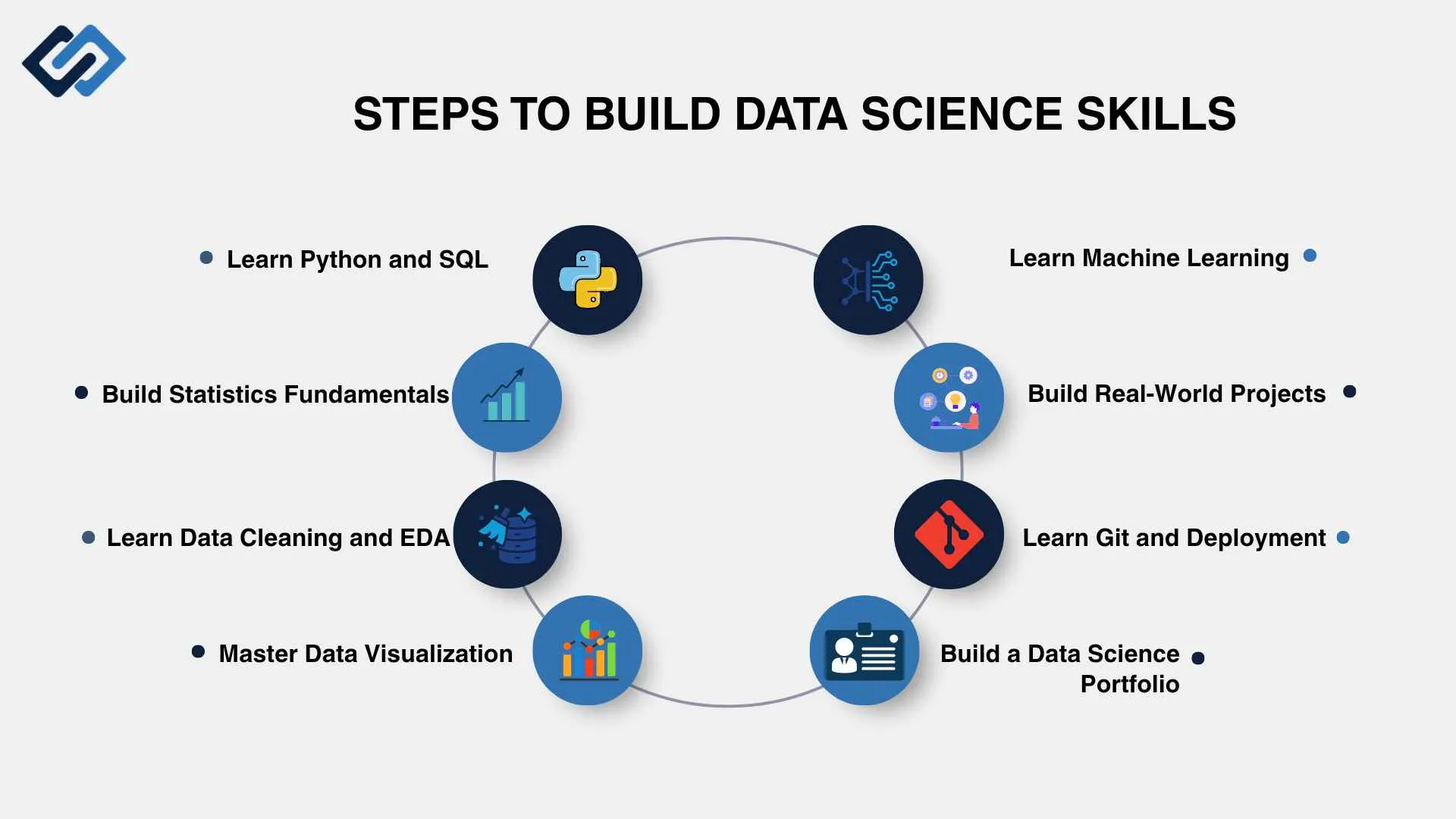
Learn Python and SQL: Focus on writing clean scripts and multi-table relational queries.
Build Statistics Fundamentals: Learn probability distributions, standard deviations, confidence intervals, and hypothesis testing frameworks.
Learn Data Cleaning and EDA: Practice loading raw datasets, imputing missing values, treating outliers, and running correlation heatmaps.
Master Data Visualization: Learn to present analytical insights clearly using chart formats tailored to specific data types.
Learn Machine Learning: Focus on practical model building with scikit-learn before touching complex deep learning architectures.
Build Real-World Projects: Solve clear operational problems using public datasets sourced from platforms like Kaggle or open government portals.
Learn Git and Deployment: Push clean code to GitHub repositories and wrap your predictive models in lightweight FastAPI interfaces.
Build a Data Science Portfolio: Publish detailed README guides that clearly explain your business problem, data cleaning steps, model trade-offs, and actionable metrics.
Common Mistakes Beginners Make When Learning Data Science
Avoid these common pitfalls to streamline your learning path:
Trying to Learn Every Tool: Do not attempt to master every framework at once. Pick Python, SQL, and scikit-learn first before adding secondary tools.
Starting With Deep Learning Too Early: Beginners often jump directly to neural networks while neglecting core tabular algorithms like XGBoost, which solve most corporate data tasks.
Ignoring SQL: Many learners spend months on complex algorithms but fail technical screening interviews because they cannot write basic database joins.
Focusing Only on Certificates: Course certificates do not land jobs; documented, working project repositories on GitHub land jobs.
Copying Projects Without Understanding Them: Tutorial-following builds false confidence. Modify public datasets and build original workflows to prove genuine problem-solving skills.
Ignoring Statistics: Treating machine learning models as black boxes without understanding baseline probability or error distribution leads to flawed predictions.
Neglecting Communication Skills: If you cannot explain your model's outputs clearly to non-technical managers, your technical work will rarely be implemented.
Using AI Without Understanding Fundamentals: Relying blindly on automated code generators without understanding core logic makes it impossible to debug production errors or optimize slow pipelines.
Building a career in data science in 2026 requires balancing core mathematical fundamentals with practical programming capabilities. By focusing on Python, SQL, statistics, and production machine learning workflows, you build a versatile skill set valued by top employers globally. Focus on building real-world projects, documenting your code on GitHub, and mastering clear technical communication.
Ready to gain job-ready expertise with live mentor feedback and hands-on projects? Explore our industry-focused online IT courses at Commit Career and take the next step toward launching your tech career today!