
September 1, 2026 · Dhiraj Bashyal
Scope of Data Science in 2026: Careers, Jobs & Salaries
On this page
The data science job market in 2026 continues to expand at a rapid rate as organizations worldwide transition from basic analytics to real-time predictive modeling and automated AI workflows. Understanding the overall data science scope is essential for international students and career changers looking to enter high-growth tech roles. If you are preparing to gain job-ready expertise in analytics, database management, and machine learning pipelines, explore our practical online IT courses to start your career transition.
Current Global Trends
Role Splitting: Companies now unbundle traditional data science tasks into specialized tracks: Data Engineers (infrastructure), Machine Learning Engineers (model deployment), and Data Analysts (business insights).
Entry-Level Competition: While overall demand remains high, hiring for junior roles has plateaued because basic tasks are increasingly automated. Mid-to-senior positions account for the vast majority of new job postings.
Strong Outlook: According to the U.S. Bureau of Labor Statistics, data science positions continue to grow much faster than average, with insights tracked closely by platforms like 365 Data Science.
What Is the Scope of Data Science?
The scope of data science spans raw database management, statistical modeling, operational forecasting, and production artificial intelligence deployment. To understand how foundational concepts connect to complex workflows, review our guide detailing data science and how it works.
Descriptive Analytics: Examining past operational performance to identify key business metrics.
Predictive Analytics: Building statistical models to forecast future customer behavior, market volatility, and operational risks.
Prescriptive & Automated AI: Training autonomous systems that execute real-time business decisions without manual intervention.
Data Science Career Paths and Job Roles
The diversity of modern data science job roles allows professionals to specialize based on their mathematical, programming, or strategic strengths.
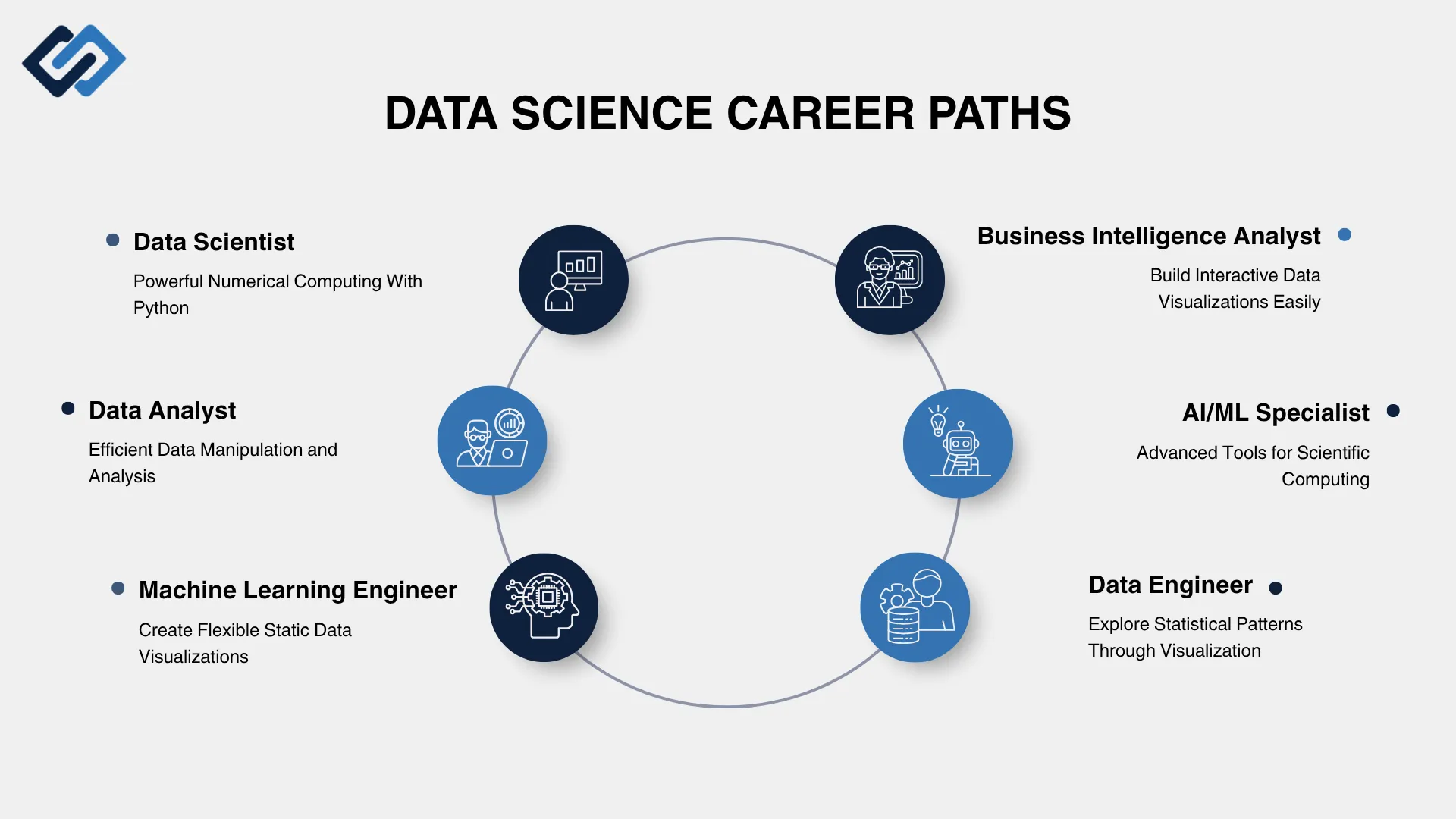
Data Scientist: Data Scientists collect, clean, and analyze complex structured and unstructured datasets to solve unstructured business problems. They design algorithms, test statistical hypotheses, and build predictive models to guide executive decisions.
Data Analyst: Data Analysts focus on analyzing historical trends, building SQL queries, and creating executive dashboards. Exploring data analytics careers provides an ideal entry pathway into tech for professionals who enjoy visual storytelling and database reporting.
Machine Learning Engineer: Machine Learning Engineers bridge software engineering and statistical modeling. They package, deploy, and scale trained machine learning models into live cloud software systems.
Data Engineer: Data Engineers build the infrastructure, data pipelines, and database architectures that supply clean data to data scientists and analytical dashboards.
Business Intelligence Analyst: Business Intelligence Analysts transform technical quantitative output into clear strategic recommendations for non-technical stakeholders and business leadership.
AI/ML Specialist: AI Specialists focus on deep neural networks, computer vision, natural language processing (NLP), and large language model (LLM) fine-tuning.
Research and Quantitative Roles: Quantitative Analysts (Quants) apply advanced probability models, stochastic calculus, and algorithmic trading logic within investment banking and financial institutions.
Data Science Jobs for Freshers and Entry-Level Professionals
Securing data science jobs entry level requires candidates to demonstrate practical technical competency over theoretical knowledge.
Entry-Level Data Science Roles
Junior Data Analyst
Associate Data Scientist
Junior Data Engineer
Business Intelligence Developer Trainee
Data Science Jobs for Freshers
There are continuous data science jobs for freshers across global markets, provided candidates understand foundational tools like SQL, Python, and statistical modeling.
Skills Employers Look For
SQL Querying: Aggregations, multi-table joins, subqueries, and window functions.
Python Scripting: Vectorized data processing using Pandas and NumPy.
Data Visualization: Storytelling using Power BI, Tableau, or Seaborn.
Version Control: Collaborative code tracking via GitHub.
How to Get Your First Data Science Job
Master Python and SQL fundamentals.
Complete end-to-end analytical case studies.
Optimize your LinkedIn profile and resume for target keywords.
Prepare for technical live coding assessments and SQL whiteboarding.
Building a Data Science Portfolio
Employers evaluate entry-level talent based on GitHub repositories. Instead of repeating basic tutorial scripts, focus on building independent data science projects that clear messy real-world data and solve genuine business challenges.
Data Science Jobs Across Industries
Data professionals work across every major commercial sector:
Finance and Banking: Financial institutions rely on algorithms for automated credit scoring, real-time transaction fraud detection, customer churn forecasting, and quantitative portfolio management.
Healthcare: Predictive analytics powers early diagnostic imaging systems, genomic research pipelines, hospital patient flow optimization, and personalized treatment modeling.
E-Commerce and Retail: Modern retail networks utilize machine learning to power recommendation engines, dynamic pricing, demand forecasting, and inventory allocation.
Technology: Software enterprises utilize data professionals to track user acquisition, optimize search engines, perform A/B testing, and power automated cloud features.
Telecommunications: Telecom operators use predictive modeling to prevent network outages, analyze customer churn risk, and optimize bandwidth allocation across regional towers.
Consulting: Global management consulting agencies deploy data teams to evaluate corporate operations, analyze mergers and acquisitions, and modernize client data infrastructure.
Global Scope of Data Science
The demand for qualified talent creates strong international employment opportunities.
Data Science Jobs in the USA
The United States represents the largest market for analytics talent, with active hiring across tech hubs like San Francisco, Seattle, and Austin. The region features continuous demand for data science jobs in New York across financial and media enterprises. If you plan to build your career in the US, explore our structured Data Science Course in the USA.
Data Science Jobs in the UK
The United Kingdom features a thriving tech landscape centered in London, Cambridge, and Manchester. Demand for data science jobs in the UK is heavily concentrated around global banking, healthcare research, and retail technology. Candidates seeking UK placement can find high demand for data science jobs in London. Prepare for this market through our dedicated Data Science Course in the UK.
Data Science Jobs in Canada
Canada has emerged as a major artificial intelligence research center, driven by tech clusters in Toronto, Vancouver, and Montreal. Upskill for regional opportunities with our comprehensive Data Science Course in Canada.
Data Science Jobs in Australia
Australian enterprises across mining, banking, and retail actively recruit international data talent. Explore dynamic data science jobs in Australia in major hubs like Sydney and Melbourne by enrolling in our mentor-led Data Science Course in Australia.
Data Science Jobs Salary: What Can You Expect?
Compensation for data roles remains high due to specialized technical requirements.
Factors That Affect Data Science Salaries
Geographic Location: Major metro hubs offer higher base pay to reflect cost-of-living standards.
Technical Specialization: Machine learning deployment and cloud data engineering command salary premiums.
Industry Sector: Investment banking, finance, and enterprise tech pay higher base compensation than non-profit or public sectors.
Years of Experience: Senior roles with architectural oversight command top tier pay packages.
Data Science Salary by Country
Source Breakdown & Citation Links
United States Data: Sourced from the U.S. Bureau of Labor Statistics and national compensation benchmarks for Data Scientists.
United Kingdom Data: Compiled from the UK National Careers Service and regional UK IT salary benchmarks.
Canada & Australia Data: Derived from international tech labor market data.
Country | Entry-Level Salary | Mid-Level Salary | Senior-Level Salary |
USA | $85,000 - $110,000 | $120,000 - $155,000 | $160,000 - $210,000+ |
UK | £35,000 - £48,000 | £55,000 - £75,000 | £80,000 - £120,000+ |
Canada | CAD $65,000 - $85,000 | CAD $90,000 - $120,000 | CAD $130,000 - $170,000+ |
Australia | AUD $80,000 - $100,000 | AUD $115,000 - $145,000 | AUD $155,000 - $200,000+ |
Data Science Job Requirements: What Employers Look For
Understanding specific data science job requirements allows candidates to streamline their study plan.
Programming Skills: Writing modular, maintainable code is foundational. Employers expect proficiency in Python or R for statistical manipulation and basic scripting.
Statistics and Mathematics: Core theoretical requirements include probability distributions, hypothesis testing, linear algebra, and multivariable calculus for model evaluation.
Data Analysis and Visualization: Candidates must demonstrate skill in exploring unstructured datasets, spotting patterns, and creating business dashboards using Power BI or Tableau.
Machine Learning: Familiarity with supervised algorithms (linear regression, decision trees, random forests) and unsupervised models (k-means clustering, PCA).
Database and Data Engineering Basics: Strong SQL skills are universal. Candidates should know how to query relational databases, perform aggregations, and optimize complex joins.
Communication and Business Skills: Data professionals must translate abstract statistical metrics into visual charts and strategic recommendations for non-technical managers.
Skills Needed to Build a Data Science Career
To remain competitive, focus on mastering key tools prioritized in modern job descriptions:
Python: Serves as the primary language and library ecosystem for statistical processing, machine learning, and predictive modeling. Start building your technical foundation by following our beginner guide on data science with Python
SQL: Functions as the universal standard for querying, filtering, and managing enterprise relational database systems.
Statistics: Understanding p-values, confidence intervals, regression analysis, and experimental A/B testing logic is essential for validating models.
Data Visualization: Mastering Matplotlib, Seaborn, Tableau, or Power BI allows professionals to communicate key findings quickly.
Machine Learning: Hands-on application using open-source frameworks like Scikit-Learn to train, validate, and tune predictive algorithms.
Data Wrangling and Preprocessing: Cleaning messy real-world data, handling missing values, encoding categorical variables, and scaling numeric features.
Cloud and Deployment Basics: Understanding cloud environments (AWS, GCP, Azure) and basic API creation (FastAPI, Flask) to make trained models accessible to applications.
Generative AI and Modern Data Tools: Familiarity with vector databases, prompt engineering, and framework integrations like LangChain.
For a complete technical evaluation, review our breakdown of data science skills and tools required in 2026
Data Science vs Other Data Careers
Understanding key career distinctions helps candidates select the right technical path based on their strengths and goals.
Career Path | Primary Focus | Core Scope & Responsibilities | Key Tools |
Data Analytics | Historical Focus | Analyzes past operational data to report what happened and produce business intelligence dashboards. | SQL, Power BI |
Data Science | Predictive Focus | Analyzes business problems using statistical algorithms and automated pipelines to forecast what will happen next. | Python, SQL, ML Models |
Data Engineering | Infrastructure Focus | Builds and manages the underlying database architectures, ETL pipelines, and data lakes required to supply clean data. | SQL, Databases, Data Lakes |
Machine Learning Engineering | System Deployment Focus | Scales, containerizes, and maintains machine learning prototypes inside live production cloud software systems. | PyTorch, Docker, Cloud Platforms |
Future Scope of Data Science
The data science future scope remains robust as technology evolves:
Automated Machine Learning (AutoML): Routine model selection and hyperparameter tuning will become automated, allowing professionals to focus on business strategy and domain context.
Ethical AI & Governance: Regulatory mandates require data scientists to audit algorithms for bias, security vulnerabilities, and regulatory compliance.
Edge Computing: Deploying lightweight machine learning models directly onto IoT devices and mobile hardware.
How to Start a Career in Data Science
Transitioning into the industry requires a structured step-by-step approach:
What Beginners Should Learn First: Begin by learning fundamental Python logic and basic SQL queries before attempting complex machine learning algorithms.
Build Practical Data Science Projects: Complete 3 to 5 original projects using public datasets from sources like Kaggle, financial portals, or public government repositories.
Create a Data Science Portfolio: Publish your code clean of excess clutter on GitHub. Include detailed README files that explain the business problem, your cleaning logic, model selection, and final metrics.
Prepare for Data Science Interviews: Practice live coding exercises, SQL join logic, statistical problem-solving, and scenario-based questions explaining how your model outputs impact business strategy.
Conclusion
The scope of data science in 2026 continues to present exceptional growth, strong salary prospects, and diverse global opportunities across multiple industries. As organizations depend increasingly on automated modeling and machine learning applications, qualified data professionals remain essential to corporate strategy. By mastering core technical tools, building a public project portfolio, and obtaining job-ready training, you can launch a successful international career in this evolving field.
Ready to build job-ready technical skills and start your career transition? Explore our mentor-led online IT courses at Commit Career and take the first step toward launching your tech career today!